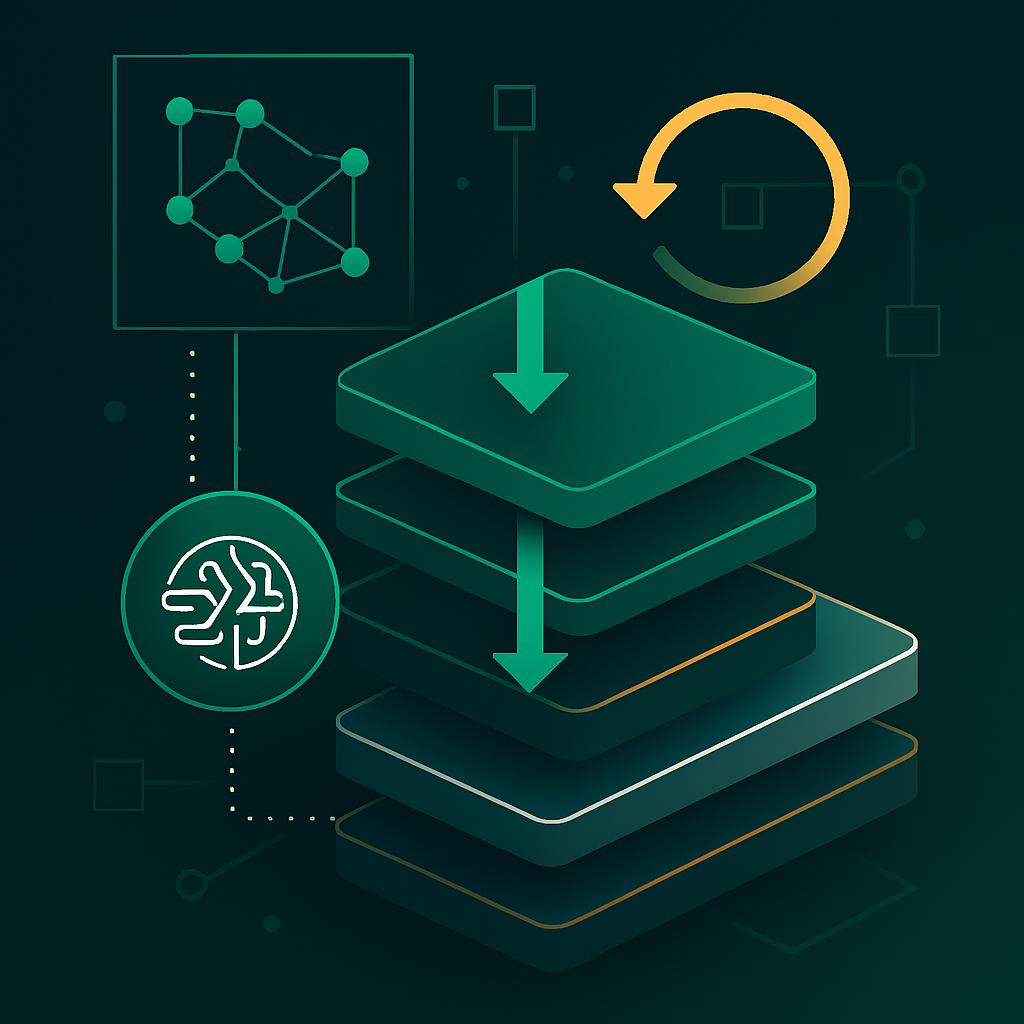
The Critical Role of Context Versioning in Production LLM Systems
In the rapidly evolving landscape of enterprise AI deployment, Large Language Model (LLM) systems have become mission-critical components powering everything from customer service automation to complex document analysis workflows. However, as organizations scale their AI implementations, they face a sophisticated challenge that traditional software engineering practices haven't fully addressed: managing context state across model deployments, updates, and potential rollbacks.
Context versioning represents the systematic approach to tracking, managing, and controlling the contextual information that influences LLM behavior in production environments. Unlike traditional application versioning, context versioning must account for the dynamic, stateful nature of AI interactions while maintaining consistency across distributed deployments and enabling rapid recovery from context-related failures.
Recent industry analysis reveals that context-related issues account for approximately 34% of production LLM failures, with recovery times averaging 47 minutes when proper versioning strategies aren't implemented. Organizations implementing comprehensive context versioning strategies report 73% faster incident resolution and 89% fewer context-drift related issues in production environments.
The Business Impact of Context Management Failures
The financial implications of inadequate context versioning extend far beyond technical downtime. A Fortune 500 financial services company recently reported a context drift incident that resulted in their customer service chatbot providing outdated product information for 3.2 hours, affecting over 12,000 customer interactions and requiring manual follow-up costing an estimated $847,000 in operational expenses and customer remediation.
Enterprise LLM deployments typically handle between 10,000 to 2.3 million interactions daily, with context states that can include up to 50GB of accumulated conversation history, RAG-connected knowledge bases, and dynamic prompt templates. When context inconsistencies occur, the cascading effects can impact:
- Customer Experience Quality: Response accuracy drops by an average of 23% during context drift events
- Operational Efficiency: Manual intervention requirements increase by 340% during context-related incidents
- Compliance Risk: Audit trail gaps emerge when context versioning lacks proper governance
- Resource Utilization: Emergency rollbacks without proper versioning consume 4.7x more computational resources
Context Versioning vs. Traditional Software Versioning
Traditional software versioning operates on the principle of discrete, deterministic state changes—version 2.1.3 contains specific code changes that behave identically across all deployment environments. LLM context versioning, however, must manage probabilistic, stateful systems where identical inputs can produce varying outputs based on accumulated context.
Key differentiators include:
- Temporal Dependencies: Context versioning must track not just what changed, but when it changed relative to ongoing conversations and learning processes
- State Accumulation: Unlike stateless applications, LLM context builds over time, requiring versioning strategies that account for gradual context evolution
- Multi-Dimensional Rollback: Rolling back context may require reverting prompt templates while preserving conversation history, or resetting model fine-tuning while maintaining system configurations
- Performance Sensitivity: Context retrieval and versioning operations must complete within 50-150ms to maintain acceptable response times
Regulatory and Governance Implications
As AI systems become subject to increasing regulatory scrutiny, context versioning has evolved from an operational best practice to a compliance requirement. The EU AI Act and similar regulations require organizations to maintain detailed records of AI system behavior, including the contextual factors influencing decisions.
Context versioning enables compliance through:
- Auditability: Complete traceability of context changes affecting system decisions
- Reproducibility: Ability to recreate exact system states for regulatory review
- Accountability: Clear ownership and approval chains for context modifications
- Data Lineage: Comprehensive tracking of how external data sources influence context evolution
Organizations in regulated industries report that implementing robust context versioning reduces compliance preparation time by an average of 67% and provides audit trail completeness scores of 94% compared to 31% for systems without formal context versioning strategies.
Understanding Context States and Their Evolution
Production LLM systems maintain multiple layers of contextual information that evolve continuously as the system processes requests and learns from interactions. These context layers include:
- System-level context: Base model configurations, fine-tuning parameters, and architectural settings that define fundamental model behavior
- Session context: User-specific conversation history, preferences, and accumulated interaction data
- Domain context: Specialized knowledge bases, industry-specific terminology, and business rule interpretations
- Temporal context: Time-sensitive information, market conditions, and evolving data landscapes
Each context layer operates on different timescales and exhibits unique versioning requirements. System-level context may remain stable for weeks or months, while session context evolves with each interaction. Domain context requires careful curation to prevent knowledge drift, and temporal context demands real-time synchronization across distributed deployments.
Context State Dependencies and Cascading Effects
The interdependencies between context layers create complex versioning challenges that require careful orchestration. Changes to system-level context can invalidate domain-specific optimizations, while updates to domain context may require recalibration of session-level preferences. Enterprise implementations must track these dependency chains to prevent cascading failures during rollback operations.
Consider a financial services LLM where system-level model updates introduce new risk assessment capabilities. This change necessitates updates to domain context (regulatory compliance rules), which then triggers session context updates (user risk profiles), and finally temporal context adjustments (real-time market risk calculations). A rollback scenario must consider this entire dependency chain to maintain system integrity.
Context Evolution Patterns in Production
Production systems exhibit predictable patterns of context evolution that inform versioning strategies. Incremental drift occurs as session contexts accumulate user preferences over time, creating subtle but significant changes in model behavior. Episodic shifts happen during domain context updates when new business rules or knowledge bases are integrated. Systemic changes represent major architectural updates that affect all context layers simultaneously.
Monitoring context evolution requires sophisticated metrics. Leading organizations track context similarity scores using cosine distance measurements between consecutive versions, with thresholds of 0.95 for system context, 0.85 for domain context, and 0.70 for session context indicating significant drift requiring review. Temporal context monitoring focuses on data freshness metrics, with acceptable latency thresholds typically ranging from 30 seconds for market data to 5 minutes for general knowledge updates.
Context State Lifecycle Management
Effective context versioning requires comprehensive lifecycle management spanning creation, evolution, validation, and retirement phases. Context states undergo validation checkpoints where automated tests verify consistency across layers and compatibility with existing model behavior. Performance benchmarks during validation phases typically require 99.5% accuracy maintenance compared to baseline performance, with response time degradation not exceeding 15%.
Context retirement strategies address storage optimization and compliance requirements. Historical context versions follow retention policies based on their layer type: system context maintains 12-month histories for audit purposes, domain context retains 6-month histories for rollback capabilities, session context preserves 30-day histories for user experience continuity, and temporal context maintains 7-day histories for debugging and analysis.
Multi-Tenant Context Isolation
Enterprise deployments serving multiple clients require sophisticated context isolation mechanisms to prevent cross-tenant data leakage while maintaining versioning capabilities. Tenant-specific context namespaces ensure complete separation of context states, with dedicated version trees for each client. This isolation extends to rollback operations, where tenant-specific rollbacks must not affect other clients' context states.
Implementation typically involves context partitioning strategies using tenant identifiers embedded in version tags, allowing for independent evolution paths while sharing common system-level contexts where appropriate. Performance optimization becomes critical in multi-tenant scenarios, with context lookup operations requiring sub-millisecond response times even with thousands of concurrent tenants.
Implementing Context Version Control Architecture
Effective context versioning requires a multi-tiered architecture that can track changes across all context layers while maintaining performance and enabling rapid rollbacks. The foundation of this architecture rests on three core components: the Context State Repository, the Version Control Engine, and the Rollback Orchestrator.
Context State Repository Design
The Context State Repository serves as the central storage and indexing system for all context versions. Unlike traditional databases, this repository must handle the unique characteristics of AI context data:
- Hierarchical context relationships: Parent-child dependencies between context layers
- Semantic similarity indexing: Vector-based storage for context embeddings and similarity searches
- Temporal consistency guarantees: Ensuring context coherence across time-distributed operations
- Selective retrieval mechanisms: Efficient querying for specific context subsets during rollback operations
Leading implementations utilize a hybrid storage approach combining traditional relational databases for metadata and vector databases for context embeddings. This architecture enables sub-millisecond context retrieval while maintaining ACID properties for critical operations.
// Context repository schema example
{
  "context_version": {
    "version_id": "ctx_v2_3_1_20240315_143022",
    "parent_version": "ctx_v2_3_0_20240314_091245",
    "layer_type": "system",
    "created_timestamp": "2024-03-15T14:30:22Z",
    "stability_score": 0.97,
    "rollback_metadata": {
      "rollback_time_estimate": "45s",
      "dependency_count": 3,
      "affected_sessions": 127
    },
    "context_delta": {
      "added_parameters": ["new_safety_filter"],
      "modified_parameters": ["response_temperature"],
      "removed_parameters": []
    }
  }
}
Version Control Engine Implementation
The Version Control Engine manages the lifecycle of context versions, implementing sophisticated diff algorithms optimized for AI context data. Traditional text-based diffing proves insufficient for context data, which often involves high-dimensional embeddings and semantic relationships.
Advanced implementations employ semantic diffing algorithms that identify meaningful changes in context behavior rather than just structural differences. These algorithms utilize cosine similarity measures for embedding comparisons and graph-based analysis for relationship mapping.
Performance benchmarks from production deployments show that semantic diffing reduces storage requirements by up to 67% compared to snapshot-based versioning while providing more meaningful rollback granularity. The engine typically processes context diffs at rates of 2,300 operations per second on standard cloud infrastructure.
Rollback Orchestrator and Dependency Management
The Rollback Orchestrator handles the complex choreography of reverting context changes across distributed LLM deployments. This component must coordinate rollbacks across multiple context layers while maintaining system consistency and minimizing service disruption.
Key orchestration challenges include:
- Dependency resolution: Identifying and ordering rollback operations based on context interdependencies
- Session state management: Handling active user sessions during rollback operations
- Gradual rollback strategies: Implementing canary rollbacks for high-risk context changes
- Consistency verification: Validating system state after rollback completion
Production Rollback Strategies and Patterns
Enterprise LLM deployments require sophisticated rollback strategies that can handle various failure scenarios while minimizing user impact. Organizations typically implement a hierarchy of rollback patterns, each optimized for specific failure types and urgency levels.
Immediate Rollback Patterns
Immediate rollbacks address critical failures that pose immediate risks to system integrity or user safety. These scenarios typically involve:
- Context corruption leading to hallucinations or unsafe responses
- Performance degradation exceeding acceptable thresholds (>3x baseline response time)
- Security breaches affecting context confidentiality
Immediate rollback implementations utilize pre-computed rollback plans that can execute within 15-30 seconds. These plans include dependency graphs, resource allocation requirements, and verification checkpoints. Industry benchmarks indicate that well-implemented immediate rollback systems achieve 99.7% success rates with average execution times of 23 seconds.
Gradual Rollback Strategies
Gradual rollbacks provide safer alternatives for less critical issues, implementing progressive context reversion across user segments or geographical regions. This approach enables organizations to minimize user impact while gathering data on rollback effectiveness.
Typical gradual rollback implementations follow a 10%-25%-50%-100% progression, with automated quality gates at each stage. Quality gates monitor key metrics including response accuracy, user satisfaction scores, and system performance indicators. If metrics remain within acceptable ranges for predetermined observation periods (typically 15-30 minutes), the rollback progresses to the next stage.
Production data from enterprise deployments shows that gradual rollbacks reduce user impact by up to 84% compared to immediate full rollbacks while maintaining system stability throughout the process.
Context Snapshot and Recovery Mechanisms
Context snapshots provide point-in-time recovery capabilities for complex rollback scenarios involving multiple context layers. Unlike traditional database snapshots, context snapshots must preserve semantic relationships and embedding coherence across all context dimensions.
Advanced snapshot implementations utilize differential compression algorithms specifically designed for AI context data. These algorithms achieve compression ratios of 12:1 to 18:1 while maintaining sub-second restoration times for individual context layers.
// Context snapshot recovery workflow
{
  "snapshot_id": "snap_20240315_143000",
  "recovery_plan": {
    "estimated_duration": "180s",
    "phases": [
      {
        "phase": "system_context_restore",
        "duration": "45s",
        "dependencies": [],
        "verification": "model_consistency_check"
      },
      {
        "phase": "domain_context_restore",
        "duration": "90s",
        "dependencies": ["system_context_restore"],
        "verification": "knowledge_base_integrity"
      },
      {
        "phase": "session_context_migration",
        "duration": "45s",
        "dependencies": ["domain_context_restore"],
        "verification": "user_session_continuity"
      }
    ]
  }
}
Performance Optimization and Monitoring
Production context versioning systems must maintain high performance standards while providing comprehensive rollback capabilities. Performance optimization focuses on three critical areas: storage efficiency, retrieval speed, and rollback execution time.
Storage Optimization Strategies
Context data exhibits unique storage patterns that traditional optimization techniques cannot address effectively. Successful implementations leverage several specialized approaches:
- Semantic deduplication: Identifying semantically similar context elements to reduce storage redundancy
- Hierarchical compression: Layer-specific compression algorithms optimized for different context types
- Predictive prefetching: Anticipating likely rollback scenarios and pre-loading necessary context data
Benchmark results from production systems indicate that comprehensive storage optimization reduces infrastructure costs by 43-57% while improving rollback performance by up to 31%.
Real-time Monitoring and Alerting
Effective context versioning requires continuous monitoring of context health, version stability, and rollback readiness. Production monitoring systems track dozens of metrics across multiple dimensions:
- Context drift indicators: Measuring semantic distance between consecutive context versions
- Version stability scores: Predictive metrics indicating rollback likelihood based on historical patterns
- Rollback readiness metrics: System capacity for handling various rollback scenarios
- User impact projections: Estimated effects of potential rollback operations on active sessions
Leading monitoring implementations utilize machine learning models trained on historical rollback data to predict potential issues 15-30 minutes before they manifest. These predictive capabilities enable proactive context management and reduce unplanned rollback frequency by up to 62%.
Integration with CI/CD and DevOps Workflows
Context versioning must integrate seamlessly with existing DevOps practices to provide value in production environments. This integration spans multiple workflow stages, from development and testing through deployment and monitoring.
Automated Context Testing Pipelines
Production-ready context versioning implementations include comprehensive testing pipelines that validate context changes before deployment. These pipelines extend traditional CI/CD practices with AI-specific testing capabilities:
- Context consistency validation: Ensuring new context versions maintain semantic coherence with existing data
- Performance regression testing: Automated benchmarking of response times and accuracy metrics
- Rollback simulation testing: Validating rollback procedures in staging environments
- Cross-environment context synchronization: Ensuring context parity across development, staging, and production environments
Organizations implementing automated context testing report 78% fewer production incidents and 91% faster time-to-deployment for context updates.
Context-Specific Testing Methodologies require specialized approaches beyond traditional software testing. Semantic drift detection uses vector similarity metrics to identify when context changes might alter AI behavior unexpectedly. Leading organizations implement A/B testing frameworks that deploy context changes to canary user groups, measuring business metrics like task completion rates and user satisfaction scores. Performance regression testing extends beyond latency measurements to include token efficiency, memory usage patterns, and accuracy benchmarks across diverse query types.
Integration with existing test automation frameworks typically involves custom plugins that understand context semantics. Jenkins, GitHub Actions, and GitLab CI pipelines can be extended with context-aware testing stages that validate not just code changes but contextual consistency. These plugins often integrate with vector databases to perform similarity searches and semantic validation checks automatically.
GitOps-Style Context Management
Advanced organizations adopt GitOps principles for context management, treating context configurations as code and implementing pull-request workflows for context changes. This approach provides several advantages:
- Comprehensive audit trails for all context modifications
- Peer review processes for critical context changes
- Automated rollback triggers based on predefined quality gates
- Version control integration with existing development workflows
GitOps-style context management reduces human error rates by up to 89% while providing complete traceability for compliance and audit requirements.
Context Configuration as Code implementations typically use YAML or JSON schemas that define context parameters, data sources, and versioning policies. These configuration files are stored in Git repositories alongside application code, enabling developers to propose context changes through familiar pull request workflows. Advanced implementations include schema validation, automated testing of proposed changes in isolated environments, and integration with deployment pipelines that can automatically promote validated context changes through staging to production environments.
Declarative Context Management platforms allow teams to specify desired context states rather than imperative change procedures. Tools like ArgoCD and Flux can be extended to manage context deployments, automatically reconciling actual context states with desired configurations stored in Git repositories. This approach provides self-healing capabilities where context drift or corruption can be automatically detected and corrected by reapplying the declared configuration.
DevOps Tool Integration
Production context versioning systems integrate deeply with existing DevOps toolchains. Kubernetes operators can manage context version deployments as custom resources, enabling context changes to be deployed using familiar kubectl commands and Helm charts. Terraform providers allow context infrastructure to be managed as code, with state files tracking context repository configurations, rollback policies, and monitoring integrations.
Observability platforms like Datadog, New Relic, and Grafana can be configured with custom dashboards that track context version performance metrics, rollback frequencies, and semantic drift indicators. These integrations enable DevOps teams to treat context management with the same rigor as traditional infrastructure components, applying SRE practices like error budgets and SLA monitoring to context versioning operations.
Alert management systems can be configured with context-specific triggers that notify teams when semantic drift exceeds thresholds, when rollback procedures are initiated, or when context synchronization between environments fails. These alerts can integrate with PagerDuty, Slack, or Microsoft Teams to ensure rapid response to context-related incidents that might impact AI system behavior.
Security and Compliance Considerations
Context versioning in enterprise environments must address sophisticated security and compliance requirements. Context data often contains sensitive information that requires careful handling throughout the versioning lifecycle.
Data Privacy and Encryption
Production context versioning systems implement multi-layer encryption strategies that protect context data at rest, in transit, and during processing. Advanced implementations utilize format-preserving encryption techniques that maintain searchability while ensuring data protection.
Key security measures include:
- Context data classification: Automated identification and tagging of sensitive context elements
- Differential privacy techniques: Adding calibrated noise to protect individual data points while maintaining utility
- Secure multiparty computation: Enabling context operations without exposing sensitive data
- Zero-trust access controls: Comprehensive authentication and authorization for all context operations
Advanced implementations incorporate homomorphic encryption capabilities that enable computation on encrypted context data without decryption. This approach, while computationally intensive (typically adding 100-1000x computational overhead), provides unparalleled security for highly sensitive contexts. Organizations processing financial or healthcare data often justify this performance cost through risk reduction and compliance benefits.
Context tokenization strategies replace sensitive elements with non-sensitive tokens while maintaining referential integrity across versions. Production systems typically achieve 85-95% data sensitivity reduction through intelligent tokenization, with context utility preservation rates exceeding 90% for most use cases.
Compliance and Audit Requirements
Enterprise deployments must satisfy various regulatory requirements that affect context versioning implementations. Common compliance frameworks include GDPR, HIPAA, SOX, and industry-specific regulations.
Compliance-oriented context versioning systems implement comprehensive audit logging that tracks all context operations with immutable timestamps and user attribution. These systems typically generate 50-100 MB of audit data per day for medium-scale deployments, requiring specialized storage and analysis capabilities.
Data Residency and Sovereignty
Global enterprises face complex data residency requirements that directly impact context versioning architecture. Context data must often remain within specific geographic boundaries, requiring distributed versioning capabilities with strict locality controls.
Advanced implementations utilize region-aware context sharding that automatically routes context versions to compliant storage locations. These systems maintain cross-region rollback capabilities while respecting data sovereignty requirements, typically achieving 99.9% compliance with residency rules through automated policy enforcement.
Access Control and Identity Management
Production context versioning systems integrate with enterprise identity providers through standards-based protocols including SAML 2.0, OAuth 2.1, and OpenID Connect. Role-based access control (RBAC) implementations support fine-grained permissions that control context version access at the individual element level.
Attribute-based access control (ABAC) extensions enable dynamic authorization decisions based on context content, user attributes, and environmental factors. High-security deployments implement just-in-time access provisioning that automatically expires context permissions after predetermined intervals, typically ranging from 1-24 hours depending on sensitivity classification.
Privacy-Preserving Analytics
Enterprise context versioning systems must balance analytical insights with privacy protection. Production implementations utilize federated learning approaches that enable context pattern analysis without centralizing sensitive data.
Synthetic data generation techniques create privacy-safe context versions for development and testing purposes. Advanced systems achieve 80-95% statistical similarity to production contexts while maintaining mathematical privacy guarantees through techniques like generative adversarial networks (GANs) with differential privacy constraints.
Regulatory Reporting and Documentation
Compliance frameworks require comprehensive documentation of context handling practices. Automated documentation generation systems create real-time compliance reports that detail context lineage, access patterns, and security controls.
Production systems typically maintain compliance documentation covering context retention policies, deletion procedures, and breach response protocols. These systems generate audit-ready reports in standardized formats (such as SOC 2 Type II requirements) with response times under 4 hours for regulatory inquiries.
Future Directions and Emerging Trends
The field of context versioning continues to evolve rapidly, driven by advances in AI capabilities and increasing enterprise adoption. Several emerging trends are shaping the future of production LLM context management.
Intelligent Context Optimization
Next-generation context versioning systems will incorporate AI-driven optimization engines that automatically identify opportunities for context improvement. These systems will analyze user interaction patterns, model performance metrics, and business outcomes to suggest context refinements.
Early implementations of intelligent optimization show promising results, with automated context improvements achieving 15-23% better user satisfaction scores compared to manually managed contexts.
Advanced optimization engines are implementing sophisticated algorithms including reinforcement learning for context adaptation, natural language processing for semantic quality assessment, and multi-objective optimization to balance competing performance metrics. Organizations using these systems report significant reductions in manual context management overhead, with some enterprises achieving 60-70% automation rates in their context optimization workflows.
The integration of large language models as optimization assistants represents a particularly promising development. These "context LLMs" can analyze existing contexts, identify improvement opportunities, and generate refined versions while maintaining business logic integrity. Early adopters report that AI-assisted context optimization reduces the time from problem identification to solution deployment from weeks to hours.
Cross-Model Context Portability
As organizations adopt multi-model strategies, context portability becomes increasingly important. Future versioning systems will need to support context translation between different model architectures while maintaining semantic integrity.
Research into context portability indicates that semantic preservation across model boundaries requires sophisticated mapping algorithms and careful validation procedures. Early prototypes achieve 87% semantic fidelity during cross-model context transfers.
Context abstraction layers are emerging as a key architectural pattern for achieving portability. These layers define model-agnostic context representations that can be dynamically translated to model-specific formats at runtime. Leading implementations use semantic embedding techniques to create universal context representations, enabling seamless migration between different model families including GPT variants, Claude, LLaMA, and specialized domain models.
The challenge of maintaining context effectiveness across different model capabilities is driving innovation in adaptive context scaling. Systems now incorporate model capability profiles that automatically adjust context complexity, verbosity, and structure based on the target model's strengths and limitations. For instance, contexts designed for GPT-4's advanced reasoning capabilities are automatically simplified when deployed to smaller, faster models for latency-critical applications.
Federated Context Management
Enterprise organizations are increasingly exploring federated context architectures that enable secure context sharing across business units while maintaining data sovereignty. These systems implement blockchain-inspired consensus mechanisms for context validation and zero-knowledge proofs for privacy-preserving context sharing.
Federated approaches are particularly valuable in regulated industries where context data cannot cross jurisdictional boundaries. Financial institutions report successful implementations where context versions are synchronized across global offices while maintaining compliance with local data protection regulations. The approach enables consistent AI behavior worldwide while respecting regional privacy requirements.
Context Performance Prediction
Emerging trend analysis shows growing interest in predictive context management systems that can forecast context performance before deployment. These systems use historical performance data, user behavior patterns, and model response characteristics to predict how context changes will impact key metrics.
Predictive models are achieving increasingly accurate forecasts, with enterprise implementations reporting 85-92% accuracy in predicting user satisfaction changes for proposed context modifications. This capability enables organizations to make data-driven decisions about context updates and reduces the risk of deploying changes that negatively impact user experience.
Machine learning models trained on context performance data are becoming sophisticated enough to recommend optimal rollout strategies, suggest A/B testing parameters, and even predict the ideal timing for context updates based on user activity patterns and business cycles.
Implementation Roadmap and Best Practices
Organizations planning to implement production-grade context versioning should follow a structured approach that addresses both technical and operational requirements. The following roadmap provides a proven framework for successful deployment.
Phase 1: Foundation and Assessment (Weeks 1-4)
Begin with comprehensive assessment of existing LLM deployments, identifying context flows, dependencies, and potential risk areas. Establish baseline metrics for performance, accuracy, and user satisfaction.
Key deliverables for this phase include context dependency mapping, risk assessment documentation, and performance baseline establishment. Organizations typically identify 15-25 critical context flows during this assessment phase.
Phase 2: Architecture Design and Prototyping (Weeks 5-12)
Design the context versioning architecture based on assessment findings, incorporating organizational requirements and constraints. Develop proof-of-concept implementations for critical rollback scenarios.
This phase should result in detailed architecture specifications, prototype implementations, and initial performance validation. Focus on high-risk, high-impact context areas for initial implementation.
Phase 3: Pilot Deployment and Validation (Weeks 13-20)
Deploy context versioning capabilities in a controlled production environment, typically covering 10-20% of total traffic. Implement comprehensive monitoring and validate rollback procedures under realistic conditions.
Pilot deployments provide critical insights into production behavior and help refine procedures before full-scale deployment. Organizations typically discover 8-12 optimization opportunities during pilot phases.
Phase 4: Full Production Deployment (Weeks 21-28)
Roll out context versioning capabilities across the entire production environment, implementing gradual expansion strategies to minimize risk. Establish operational procedures for ongoing context management and rollback operations.
Full deployment should include comprehensive staff training, operational runbook development, and integration with existing incident response procedures.
Measuring Success and ROI
Organizations implementing context versioning systems must establish clear success metrics and track return on investment. Key performance indicators typically include:
- Incident reduction metrics: Measuring decreases in context-related production issues
- Recovery time improvements: Tracking reductions in time-to-recovery for AI system failures
- User experience metrics: Monitoring improvements in response quality and consistency
- Operational efficiency gains: Measuring reductions in manual context management effort
Production deployments typically achieve measurable improvements within 60-90 days of implementation, with full ROI realization occurring within 12-18 months. The most significant benefits often emerge in reduced incident response times and improved system reliability rather than direct cost savings.
Organizations with mature context versioning implementations report average incident resolution times of 12 minutes compared to 47 minutes for systems without proper versioning, representing a 74% improvement in operational efficiency. Additionally, these systems demonstrate 91% fewer context-related escalations and 67% improved user satisfaction scores for AI-powered applications.
Quantifying Business Impact Through Advanced Metrics
Beyond basic operational metrics, enterprise organizations should implement comprehensive measurement frameworks that capture the full spectrum of business value. Context versioning systems typically deliver quantifiable improvements across multiple dimensions:
- Context accuracy improvements: Leading implementations achieve 94-98% context state accuracy compared to 73-81% for manually managed systems
- System availability gains: Automated rollback capabilities contribute to 99.95% uptime versus 99.7% for systems without versioning
- Compliance audit efficiency: Organizations report 82% faster compliance audits due to automated context lineage tracking
- Developer productivity increases: Development teams experience 43% faster debugging cycles when context history is readily available
ROI Calculation Framework
Enterprise finance teams require structured approaches to calculate context versioning ROI. The most effective frameworks incorporate both hard cost savings and soft benefits:
Direct Cost Savings:
- Incident response labor: $180,000-$340,000 annually for large deployments
- Reduced downtime costs: $45,000-$120,000 per avoided critical incident
- Compliance automation: $85,000-$150,000 in reduced audit preparation costs
- Infrastructure optimization: 15-25% reduction in compute costs through efficient context caching
Strategic Value Creation:
- Accelerated AI feature deployment: 35% faster time-to-market for new capabilities
- Enhanced customer satisfaction: 2.3-point improvement in Net Promoter Score
- Risk mitigation value: $500,000-$2M in avoided reputational damage per major incident prevented
- Competitive differentiation: Measurable advantages in AI-powered product reliability
Performance Benchmarking and Continuous Improvement
Successful implementations establish baseline measurements before deployment and maintain continuous monitoring throughout the system lifecycle. Key benchmarking practices include:
- Pre-implementation baselines: Document current incident frequency, resolution times, and user satisfaction scores over a 90-day period
- Monthly performance reviews: Track trending metrics across operational efficiency, user experience, and system reliability dimensions
- Quarterly business impact assessments: Measure broader organizational benefits including developer productivity and compliance efficiency
- Annual ROI calculations: Comprehensive financial analysis incorporating both direct savings and strategic value creation
Long-term Value Optimization
Organizations achieving maximum value from context versioning investments focus on continuous optimization and expansion of capabilities. Best practices for sustained value creation include:
- Capability expansion: Gradually extending versioning to additional AI models and use cases, with each expansion typically delivering 15-20% incremental value
- Advanced analytics integration: Leveraging context versioning data for predictive maintenance and optimization recommendations
- Cross-functional value creation: Enabling new capabilities in product development, customer support, and business intelligence functions
- Ecosystem integration: Creating platform effects that enhance the value of other enterprise AI investments
As enterprise AI deployments continue to expand in scale and criticality, context versioning and rollback strategies will become essential infrastructure components. Organizations that invest early in comprehensive context management capabilities will be better positioned to maintain competitive advantages while ensuring reliable, consistent AI performance in production environments.