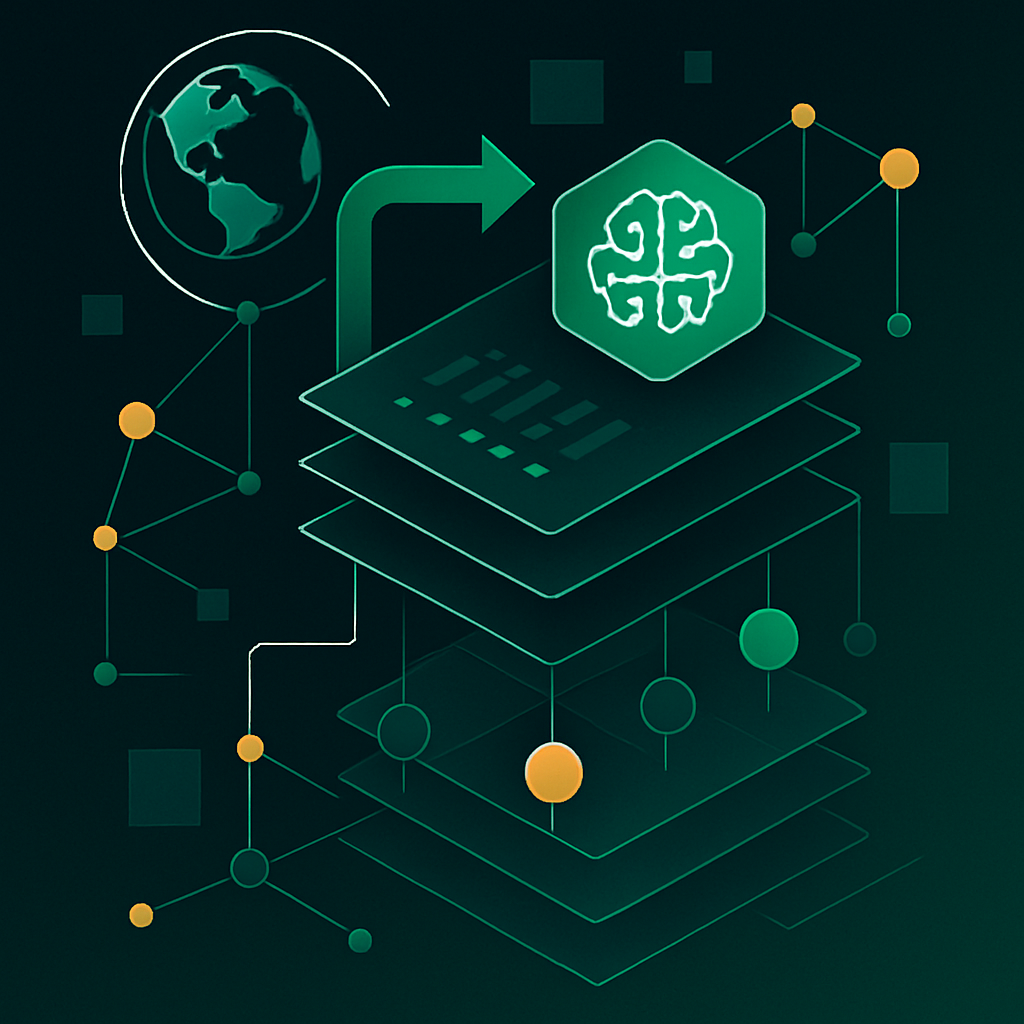
Most conversations about enterprise AI fixate on the model — how large it is, which benchmark it topped this month. In practice, the model is rarely the thing that decides whether a deployment is trustworthy. The thing that decides it is context: does the system have the right information for the task in front of it, and only the right information?
That question — how an AI system knows what it needs to know, when it needs to know it, and nothing it shouldn't — is the whole discipline of context management. Get it right and a mid-sized model becomes dependable. Get it wrong and the most capable model on the market will still hallucinate, leak, and produce answers no one can defend.
Why ungrounded AI fails in the enterprise
An assistant that answers from "everything it has ever seen" fails in three specific, predictable ways:
- It hallucinates. Asked something outside its knowledge, a language model will produce a fluent, confident answer anyway. In a consumer chatbot that's an annoyance. In a contract, a diagnosis, or a compliance filing, it's a liability.
- It leaks across boundaries. An assistant that quietly accumulates whatever you feed it will happily surface one customer's data in another customer's session. Multi-tenant products live or die on the guarantee that this cannot happen.
- It can't show its work. An answer with no source is a rumor. If the system can't point to the specific document a claim came from, you can't audit it, defend it, or trust it at scale.
None of these are fixed by a bigger model. They're fixed by managing context.
Consequences of Ungrounded AI in Regulated Industries
In regulated industries such as healthcare, finance, and government, the consequences of ungrounded AI can be severe. For instance, a Large Language Model (LLM) that hallucinates can lead to incorrect diagnoses or treatment plans, resulting in harm to patients. Similarly, in finance, a model that leaks sensitive customer information can lead to General Data Protection Regulation (GDPR) violations and significant fines. In government, ungrounded AI can compromise national security by failing to adhere to Health Insurance Portability and Accountability Act (HIPAA) guidelines.
Technical Debt and the Cost of Ungrounded AI
The cost of ungrounded AI can be substantial, with estimates suggesting that Data Loss Prevention (DLP) and Identity and Access Management (IAM) breaches can cost organizations upwards of $3.86 million per incident. Furthermore, the technical debt accumulated by attempting to fix these issues with bigger models or Software Development Kits (SDKs) can be staggering. A more effective approach is to invest in Model Context Protocol (MCP) and Enterprise Context Management (ECM) to ensure that AI systems are grounded in the right context from the outset.
Grounding AI with Provenance and Observability
To address the limitations of ungrounded AI, organizations must prioritize provenance and observability. This involves implementing Change Data Capture (CDC) and Extract, Transform, Load (ETL) processes to track data lineage and ensure that AI systems can provide transparent and explainable outputs. By doing so, organizations can build trust in their AI systems and ensure that they are compliant with relevant regulations such as SOC 2 and GDPR.
By recognizing the limitations of ungrounded AI and prioritizing context management, organizations can build more trustworthy and effective AI systems that drive business value and minimize risk.
The four principles of grounded context
Whether you build it yourself or buy it, a trustworthy context layer holds to four principles.
1. Grounded retrieval, with citations
The system should answer from a defined corpus — your documents, your records, your knowledge base — not from the open world. And every answer should resolve back to the source it came from. Retrieval without citation is just a more elaborate way to guess.
2. Scope isolation by default
Context has to be bounded, and the boundary has to be the default rather than a setting someone remembers to switch on. The clean way to model this is a scope path — a hierarchy like workspace → team → user (or, in a matter-based system, workspace → matter). A query resolves the branch it belongs to and its ancestors, and never a sibling branch belonging to someone else.
3. Provenance and observability
Every retrieval and every model call should be traceable: which context was pulled, which sources an answer used, what it cost. This isn't paperwork — it's what turns "the AI said so" into something you can put in front of an auditor, a regulator, or a judge.
4. Treat it as a layer, not a prompt
The instinct is to solve context with a longer system prompt. That doesn't scale and it doesn't isolate. Context management is infrastructure — retrieval, scoping, memory, and provenance sitting beneath every AI feature — not a paragraph you paste into a chat window.
Where this sits: the Foundations™ layer
We think of context management as one of five foundations every serious enterprise AI capability needs: grounded retrieval, context management, multi-model routing, provenance and observability, and integration with the systems where work actually happens. The value isn't any single pillar — it's that they're built once, correctly, and everything above them inherits the guarantees.
Foundations for Enterprise AI
The five Foundations pillars work together to ensure that AI systems are dependable, efficient, and scalable. By establishing a robust context management system, enterprises can provide a solid foundation for their AI capabilities, enabling them to build more accurate and reliable models. This, in turn, leads to better decision-making and improved business outcomes. The Five Foundations are:
- Grounded Retrieval: enabling AI systems to retrieve and process relevant data in a timely and efficient manner
- Context Management: providing a framework for understanding and managing the context in which AI systems operate
- Multi-Model Routing: allowing AI systems to seamlessly integrate with multiple models and systems, ensuring that the right data gets to the right model at the right time
- Provenance and Observability: providing a clear understanding of where data comes from, how it's being used, and what's happening to it throughout the AI pipeline
- Integration with Systems of Record: ensuring that AI systems are integrated with the systems where work actually happens, such as CRM, ERP, and other core business systems
Benefits of the Foundations Approach
By building on the Five Foundations, enterprises can realize significant benefits, including:
- Improved Accuracy: by providing a solid foundation for AI systems, enterprises can build more accurate and reliable models
- Increased Efficiency: the Five Foundations enable AI systems to process and retrieve data more efficiently, reducing latency and improving overall system performance
- Enhanced Scalability: by establishing a robust context management system, enterprises can scale their AI capabilities more easily, without sacrificing performance or accuracy
- Better Decision-Making: the Five Foundations provide a framework for understanding and managing context, enabling enterprises to make better-informed decisions
According to a recent study, enterprises that adopt a foundations-based approach to AI see an average increase of 25% in model accuracy and a 30% reduction in development time.
By adopting a foundations-based approach to AI, enterprises can establish a robust and scalable context management system, enabling them to build more accurate and reliable models, and ultimately drive better business outcomes.
Where it matters most
The clearest place to see grounded, scoped context in action is somewhere the cost of getting it wrong is highest: legal discovery. There, "the AI can only see the evidence in this one matter" isn't a nice-to-have — it's the difference between a defensible tool and a privilege incident. We wrote up exactly how that plays out: See your evidence — don't just search it.
The legal case is dramatic, but the discipline is universal. Any enterprise putting AI near real data is making the same bet — that the system knows the right things, only the right things, and can prove where each answer came from. That bet is won or lost at the context layer.
Regulated industries and high-stakes context
In highly regulated industries such as finance, healthcare, and government, the importance of grounded context cannot be overstated. A single misstep in data handling or AI decision-making can result in severe fines, reputational damage, or even loss of licenses. For instance, the General Data Protection Regulation (GDPR) and Health Insurance Portability and Accountability Act (HIPAA) impose strict requirements on data handling and protection. In these environments, implementing a robust context management framework is essential to ensure compliance and mitigate risks.
For example, in financial services, AI-powered systems are increasingly used for risk assessment, credit scoring, and portfolio management. However, these systems must be able to demonstrate transparency, explainability, and fairness in their decision-making processes. A well-designed context layer can provide the necessary foundation for these requirements, enabling organizations to meet regulatory demands and maintain customer trust.
Measuring the ROI of grounded context
While the benefits of grounded context may seem intuitive, quantifying its value can be challenging. However, by considering the following metrics, organizations can estimate the potential ROI of implementing a robust context management framework:
- Reduced risk of non-compliance: By ensuring that AI systems operate within well-defined boundaries and adhere to regulatory requirements, organizations can minimize the risk of costly fines and penalties.
- Improved data quality and accuracy: Grounded context helps to eliminate data inconsistencies and errors, leading to more reliable insights and better decision-making.
- Enhanced transparency and explainability: By providing clear visibility into AI decision-making processes, organizations can build trust with customers, regulators, and stakeholders.
- Increased efficiency and productivity: A well-designed context layer can streamline data management, reduce manual effort, and enable faster deployment of AI-powered applications.
By considering these factors and implementing a robust context management framework, organizations can unlock significant value and achieve a substantial return on investment in grounded context.
Ultimately, the importance of grounded context extends far beyond legal discovery or regulated industries. As AI becomes increasingly ubiquitous in enterprise operations, the need for a robust context management framework will only continue to grow. By prioritizing grounded context and investing in its development, organizations can unlock the full potential of AI, drive business success, and maintain the trust of their customers and stakeholders.