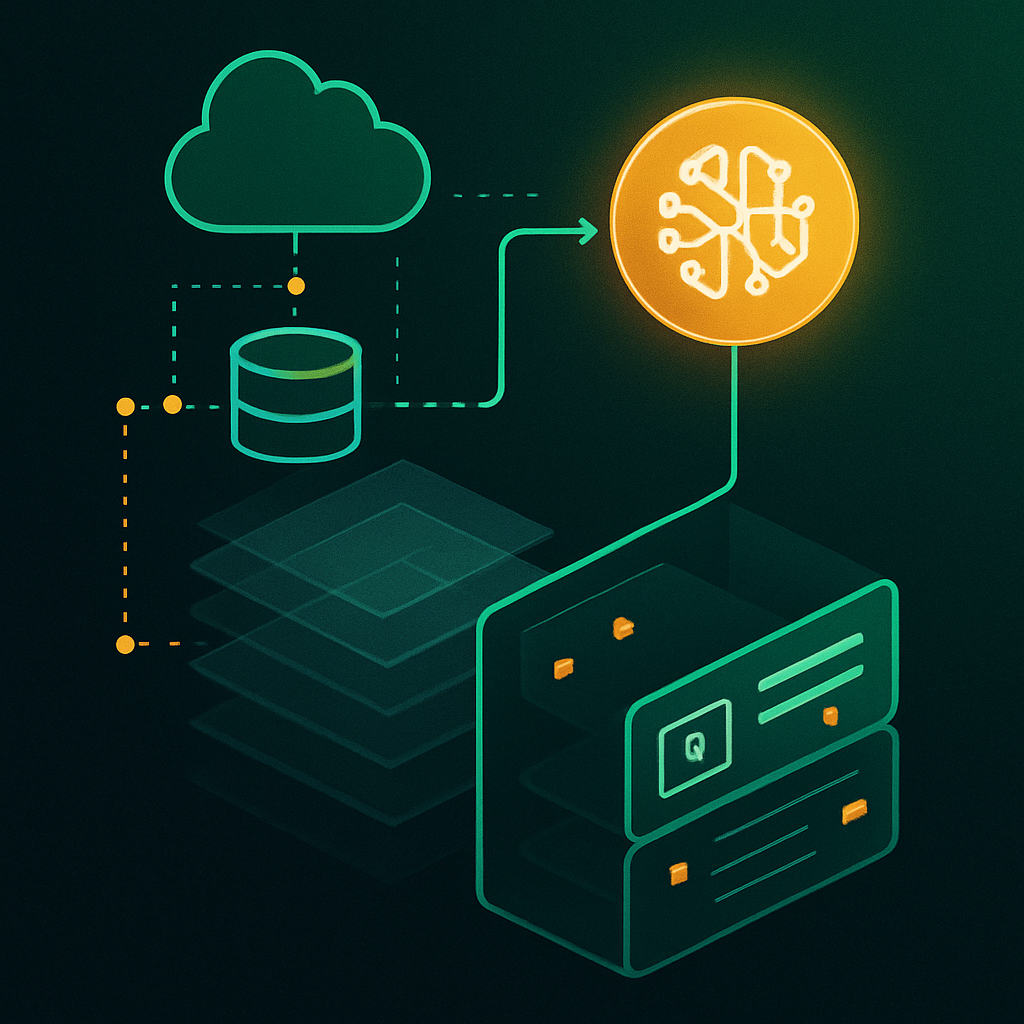
Understanding Data Gravity and Its Impact on AI Context Integration
Data gravity refers to the tendency of large datasets to attract applications, services, and other data. In the context of AI and enterprise data management, data gravity can significantly influence the strategic direction of technology adoption and integration efforts. As AI systems rely heavily on data for training and inference, the gravitational pull of data sources can affect the efficiency and effectiveness of AI implementations.
The Science Behind Data Gravity
The concept of data gravity was first introduced to explain how large data sets exert a pull, influencing the location of other data and applications. As data accumulates, the 'weight' of the dataset increases, making it more challenging and resource-intensive to move. This phenomenon creates a natural tendency for computing resources to be positioned closer to large datasets to reduce latency and data transfer costs.
Strategic Shifts in Data Storage for AI Context Management
Effective AI context integration requires a strategic approach to data storage, where enterprises must consider the balance between centralized and distributed data architectures. The placement of data affects not only the performance of AI models but also cost implications associated with data transfer and storage.
Centralized vs. Distributed Data Architectures
In a centralized architecture, data is stored at a single location, reducing latency for local access and simplifying data management. However, this can increase exposure to data gravity challenges, particularly for global enterprises with geographically dispersed operations. Conversely, a distributed architecture can mitigate data gravity by placing data closer to where it's needed, but it complicates data consistency and governance.
Enterprises must evaluate their specific needs and constraints to design an architecture that balances performance, cost, and governance.
Navigating Compliance and Governance Challenges
Compliance and governance represent fundamental challenges in managing data gravity, particularly in highly regulated sectors such as finance and healthcare. Ensuring data sovereignty while facilitating efficient data flow requires meticulous planning and execution.
GDPR, HIPAA, and Beyond
Regulations such as GDPR and HIPAA impose strict requirements on data storage and transfer, often restricting data movement across boundaries. These requirements necessitate robust data governance frameworks that ensure compliance while enabling the strategic deployment of AI solutions.
Governance Frameworks
A solid governance framework addresses data ownership, metadata management, and access controls, ensuring that data remains compliant and secure as it gravitates within and outside the enterprise boundaries.
Maximizing Business Value Through AI Context Integration
When enterprise decision-makers successfully navigate data gravity challenges, they can unlock substantial business value from AI systems. By strategically locating data and computational resources, organizations can accelerate AI adoption, enhancing decision-making and operational efficiency.
ROI Considerations
The return on investment (ROI) for AI initiatives is a critical metric for enterprise leaders. By minimizing data transfer costs and improving AI model performance, organizations can achieve higher ROI, justifying the investment in strategic data management initiatives.
Recommendations for Enterprises
- Conduct a thorough data architecture assessment: Identify data gravity hotspots and their impact on current and future AI projects.
- Integrate compliance with strategy: Develop a governance framework that aligns with business objectives and regulatory requirements.
- Design a hybrid cloud strategy: Utilize cloud infrastructure intelligently to manage data gravity challenges efficiently.
- Monitor and adjust: Continuously evaluate the impacts of data gravity on AI deployment, adjusting strategies as technologies and regulations evolve.
Conclusion
Data gravity is a pivotal concept in enterprise AI context integration, affecting everything from data architecture to compliance and ROI. By understanding and strategically managing data gravity, enterprises can foster successful AI implementations that drive significant business value.
Strategic Alignment with Business Objectives
To effectively manage data gravity, enterprises must first ensure that their AI context strategies are aligned with overarching business objectives. This involves a clear assessment of how data-driven insights can underpin strategic goals across departments. For instance, an enterprise in the retail sector might leverage AI for context-driven analytics to enhance customer satisfaction and operational efficiency, aligning with business goals of increasing market share and optimizing supply chains.
Initiatives should start with defining key performance indicators (KPIs) that directly relate to business outcomes. For those looking to enhance customer engagement, metrics such as customer lifetime value or customer churn rates may be relevant. By aligning AI capabilities with such metrics, enterprises can more effectively assess the ROI of data gravity management strategies.
Adopting an Adaptive Data Strategy
An adaptive data strategy is crucial to managing data gravity, particularly in mitigating latency and bandwidth issues that arise as data volumes grow. This involves not only choosing between centralized and distributed architectures but also implementing a hybrid model that flexibly adapts to load and processing requirements. Leveraging cloud-based solutions, like a VPC, can mitigate data gravity by enabling scalable compute resources that are closer to where data is generated and consumed.
Moreover, edge computing should be considered for applications that require rapid data processing and low-latency responses. Enterprises such as those in the IoT (Internet of Things) space can benefit significantly from processing data close to its source, which helps to lessen the gravitational pull of data clusters by distributing compute processes.
Technological Enhancements and Innovations
To tackle challenges brought about by data gravity, enterprises should actively seek out and invest in technological enhancements. Advanced data integration technologies, including RAG strategies, offer promising solutions by effectively combining external and internal data sources to enable real-time decision support via LLMs. Additionally, utilizing robust ETL or ELT pipelines ensures data remains clean and accessible, which is critical when integrating multiple sources of high-velocity data.
Emerging technologies such as 5G networks and AI-driven data orchestration tools can also diminish the effects of data gravity by enhancing connectivity and accelerating data processing speeds. Businesses in sectors such as telecommunications and financial services could greatly benefit from these technological advancements by improving real-time data accessibility and minimizing latency in data transfer and processing.
Ensuring Robust Compliance and Governance
Strategic management of data gravity goes hand-in-hand with impeccable compliance and governance practices. Enterprises must ensure that data movements, both at rest and in transit, adhere to current standards such as GDPR and HIPAA. Failure to do so not only risks legal repercussions but can also severely damage brand reputation and stakeholder trust.
Implementing comprehensive governance frameworks, like those aligned with NIST standards, can streamline compliance while fostering a culture of accountability and continuous improvement. This can be achieved by using cloud-native governance tools that provide real-time monitoring and auditing capabilities, facilitating rapid response to compliance violations.
Navigating the Future Landscape
As data continues to grow exponentially, the challenge of managing data gravity will become more pronounced. Enterprises must remain proactive, keeping abreast of technological advancements and evolving data governance requirements. Developing capabilities in ECM and adopting frameworks such as MCP will be critical for effective AI context integration.
The enterprises that succeed will be those able to deftly navigate the complexities of data gravity, capitalizing on its nuances to drive innovation, enhance operational efficiency, and generate sustainable business value. Therefore, ongoing strategic review processes and an agile approach to technology adoption will be essential in maintaining a competitive edge in the rapidly evolving digital landscape.