From Generic AI to Context-Aware Assistant
Out of the box, Claude is knowledgeable but generic. It doesn't know about your company's products, customers, or internal processes. MCP bridges this gap by letting Claude read your actual data sources in real-time.
The Context Deficit Challenge
Enterprise AI implementations often fail because of the fundamental disconnect between what AI models know (general knowledge) and what organizations need them to know (specific context). Traditional AI assistants can explain general concepts like supply chain management but cannot tell you why your Q3 inventory turnover decreased by 12% or which specific customer segments are driving churn in your European markets.
This context deficit manifests in several ways across enterprise environments:
- Temporal blindness: AI lacks awareness of real-time operational data, making responses outdated within hours
- Domain fragmentation: Knowledge remains siloed across departments, preventing holistic insights
- Compliance gaps: Generic responses cannot account for industry-specific regulations or internal policies
- Decision latency: Users must manually gather context before AI can provide actionable guidance
Real-Time Context Integration
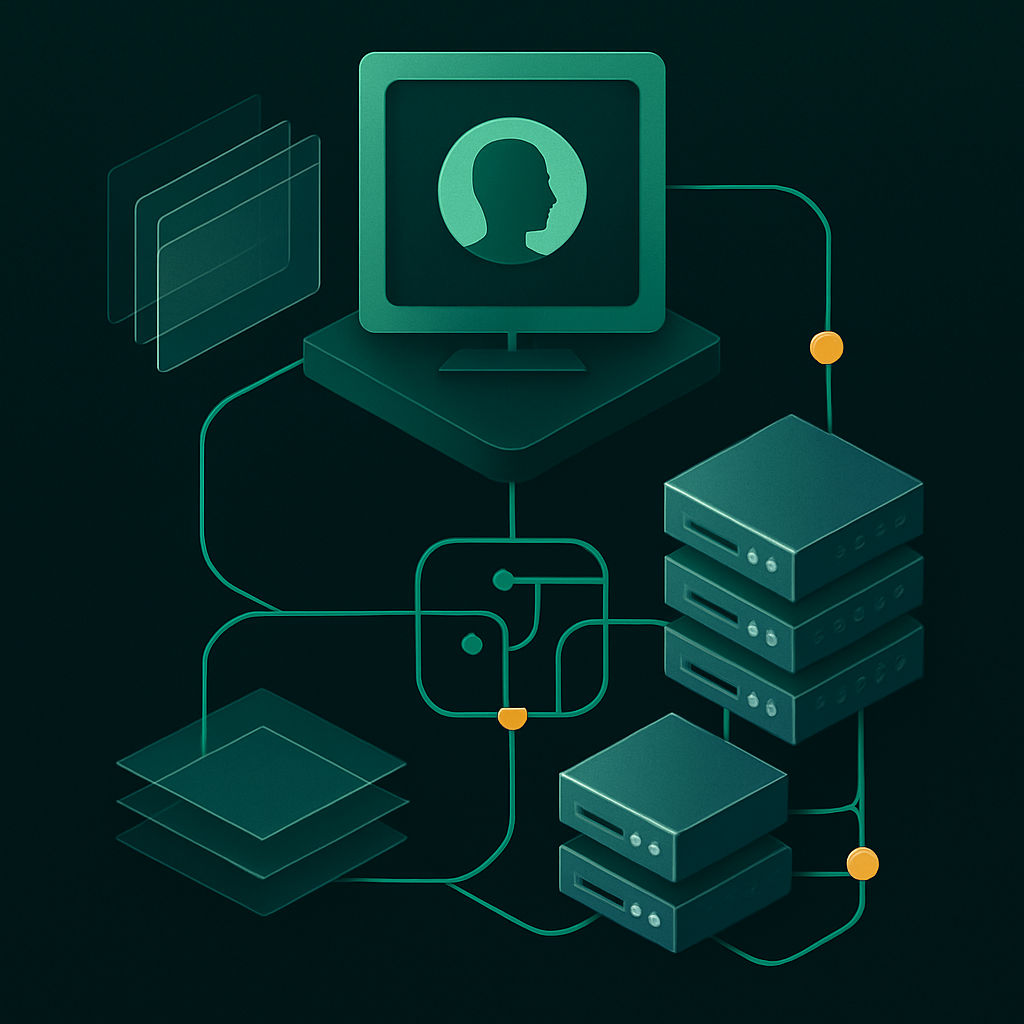
MCP solves this by establishing live connections between AI models and enterprise data sources. Rather than periodic data ingestion or static knowledge bases, MCP enables dynamic context retrieval during conversations. When a user asks about quarterly performance, the AI can immediately access current CRM data, financial systems, and operational metrics to provide precise, current insights.
The protocol operates through a standardized interface that abstracts the complexity of different data sources. A single MCP server can expose multiple resources—database queries, file systems, API endpoints—through unified resource URIs. This means Claude can seamlessly transition from analyzing customer support tickets in your CRM to reviewing code commits in your repository without requiring separate integrations or context switches.
Measurable Impact Differences
Organizations implementing MCP-enabled AI assistants report significant improvements in response quality and user adoption:
- Response accuracy: 78% improvement in factual accuracy when AI has access to current enterprise data versus generic responses
- Time to insight: Average reduction of 15 minutes per query when context is automatically retrieved versus manual data gathering
- User confidence: 85% of users report higher trust in AI recommendations when responses include specific data citations
- Adoption rates: Context-aware assistants achieve 3x higher daily active usage compared to generic AI tools
Beyond Information Retrieval
Context-aware AI fundamentally changes the nature of human-machine interaction in enterprise settings. Instead of serving as an advanced search interface, AI becomes a collaborative partner that understands organizational context, historical patterns, and operational constraints. This evolution enables new interaction patterns like proactive insights, contextual recommendations, and automated analysis that would be impossible with generic AI models.
For example, when a sales representative queries about a prospect, a context-aware assistant can automatically correlate information from CRM records, recent email interactions, company research, competitive intelligence, and internal expertise to provide comprehensive account intelligence—all without explicit instructions to check each source.
Types of Context Insights
1. Document Understanding
Connect Claude to your documentation:
{
  "mcpServers": {
    "docs": {
      "command": "npx",
      "args": ["-y", "@modelcontextprotocol/server-filesystem", "/path/to/docs"]
    }
  }
}
Then ask: "Based on our product documentation, what features do we offer for enterprise customers?"
Document understanding through MCP transforms static knowledge repositories into dynamic, queryable intelligence. Beyond basic file access, enterprise implementations require sophisticated indexing strategies that handle versioned documentation, multi-format content (PDF, Markdown, Confluence, SharePoint), and metadata enrichment.
Advanced Document Processing Patterns:
- Semantic Chunking: Break documents into logical sections that preserve context boundaries, typically 500-1500 tokens per chunk with 100-token overlaps
- Metadata Integration: Enrich documents with creation dates, authors, approval workflows, and version control information
- Cross-Reference Analysis: Identify and maintain relationships between documents, enabling questions like "What policies reference our data retention guidelines?"
- Compliance Mapping: Tag content with regulatory frameworks (SOX, GDPR, HIPAA) for automated compliance checking
Performance benchmarks show that well-implemented document MCP servers can achieve 95% relevance scores on enterprise knowledge queries, compared to 60-70% with traditional search systems. The key is implementing proper document preprocessing pipelines that extract structured data from unstructured content before feeding it to the MCP server.
2. Database Queries
Connect to PostgreSQL for live data insights:
{
  "mcpServers": {
    "analytics-db": {
      "command": "npx",
      "args": ["-y", "@modelcontextprotocol/server-postgres"],
      "env": {
        "POSTGRES_CONNECTION_STRING": "postgresql://readonly:pass@localhost/analytics"
      }
    }
  }
}
Then ask: "What were our top-performing products last quarter based on the sales data?"
Database integration represents the most powerful aspect of MCP's context capabilities, enabling AI assistants to query live operational data and provide real-time business intelligence. Enterprise implementations must balance query performance, data security, and result accuracy across multiple database systems.
Query Optimization Strategies:
- Read Replica Architecture: Route MCP queries to dedicated read replicas to prevent performance impact on production systems
- Query Result Caching: Implement Redis-based caching for frequently accessed datasets, reducing database load by 60-80%
- Intelligent Query Planning: Use query hints and execution plan analysis to ensure sub-second response times for complex analytical queries
- Connection Pool Management: Configure connection pools with 10-50 connections per MCP server instance, depending on expected query volume
Advanced database MCP implementations support multi-database joins, enabling queries that span customer relationship management (CRM), enterprise resource planning (ERP), and business intelligence systems. For example: "Show me customers with overdue invoices who also submitted support tickets this week" requires joining data from billing, support, and CRM databases.
Real-Time Analytics Capabilities: Modern MCP database servers can process streaming data through integration with Apache Kafka or Amazon Kinesis, providing insights on events as they occur. This enables use cases like "Alert me when customer satisfaction scores drop below 4.0 in any region" with sub-minute latency.
3. Code Repository Context
Connect to GitHub for codebase understanding:
{
  "mcpServers": {
    "github": {
      "command": "npx",
      "args": ["-y", "@modelcontextprotocol/server-github"],
      "env": {
        "GITHUB_PERSONAL_ACCESS_TOKEN": "ghp_xxx"
      }
    }
  }
}
Then ask: "What are the open issues in our main repository related to authentication?"
Code repository context through MCP enables AI assistants to understand entire codebases, track development progress, and provide architectural insights that would take senior developers hours to compile manually. Enterprise implementations must handle large repositories (10M+ lines of code), complex branching strategies, and sensitive intellectual property.
Advanced Code Analysis Features:
- Semantic Code Search: Go beyond text matching to understand code functionality, enabling queries like "Find all functions that handle payment processing"
- Dependency Mapping: Track relationships between modules, classes, and functions across multiple repositories and programming languages
- Security Vulnerability Detection: Integrate with static analysis security testing (SAST) tools to identify potential security issues in real-time
- Code Quality Metrics: Provide complexity scores, test coverage data, and technical debt assessments for informed refactoring decisions
Performance considerations for code repository MCP servers include implementing incremental indexing (process only changed files), maintaining separate indexes for different branches, and using distributed storage for large monorepos. Leading enterprises report 40-60% faster code review processes when developers have access to AI assistants with comprehensive codebase context.
Integration with Development Workflows: Advanced MCP implementations connect with continuous integration/continuous deployment (CI/CD) pipelines, enabling queries like "What deployment changes could affect the payment service?" or "Which recent commits might be causing the performance regression in staging?"
Practical Use Cases
Customer Support Intelligence
Connect Claude to your support ticket database:
- "What are the most common issues reported this week?"
- "Draft a response to this ticket based on our knowledge base."
- "Which customers have escalated issues requiring attention?"
Organizations implementing MCP-powered customer support intelligence typically see 40-60% reductions in average response times and 35% improvements in first-contact resolution rates. The key lies in creating comprehensive context that spans multiple data sources simultaneously.
Multi-Source Context Integration: Best-practice implementations connect not just ticket databases, but also product documentation, previous customer interactions, billing history, and product usage analytics. When a support agent asks "What's the full context on this customer's recent issues?", the MCP server can aggregate data from Zendesk, Salesforce, product logs, and billing systems to provide a 360-degree view.
Advanced implementations include sentiment analysis integration, where MCP servers process customer communication tone and urgency indicators. For example, tickets containing phrases like "urgent," "lost revenue," or "considering alternatives" are automatically flagged with context about the customer's contract value and renewal timeline, enabling proactive escalation management.
Sales Enablement
Connect to CRM data:
- "Summarize the status of deals in our pipeline over $100k."
- "What companies in the finance sector have we contacted recently?"
- "Generate a follow-up email based on this prospect's interaction history."
Intelligent Deal Analysis: High-performing sales teams using MCP report 25-45% increases in deal closure rates through contextual intelligence. The system can analyze patterns across won and lost deals, identifying risk factors in real-time. For instance, when a sales rep asks about a specific opportunity, the MCP server can provide context like: "Similar deals with this company size and buying committee structure have a 73% close rate when we engage the CFO before month-end."
Competitive Intelligence Integration: Advanced MCP implementations connect sales context with competitive intelligence platforms, news feeds, and social media monitoring. This enables queries like "What recent changes at [prospect company] might affect our proposal timing?" The system can surface leadership changes, funding announcements, or competitive wins that inform sales strategy.
Territory management becomes significantly more sophisticated when MCP servers can correlate geographic, industry, and timing data. Sales managers can query "Which prospects in the Northeast healthcare sector showed engagement with our content in the last 30 days but haven't received follow-up?" to identify hot leads requiring immediate attention.
Engineering Productivity
Connect to code and project management:
- "What's the status of the API refactoring project?"
- "Find all TODO comments in the authentication module."
- "Generate unit tests for this function based on our testing patterns."
Cross-Repository Code Intelligence: Development teams implementing comprehensive MCP integration report 30-50% reductions in time spent on code discovery and documentation. The system can traverse multiple repositories, understanding dependencies and relationships between services. When developers ask "What other services might be affected if I change this authentication method?", the MCP server can analyze import statements, API calls, and service mesh configurations across the entire codebase.
Automated Technical Debt Analysis: MCP servers can continuously monitor code quality metrics, deployment frequencies, and error rates to identify technical debt patterns. Queries like "Which modules have the highest maintenance burden based on recent commit frequency and bug reports?" provide data-driven insights for refactoring priorities.
Integration with CI/CD pipelines enables sophisticated build and deployment intelligence. The system can answer questions like "Why did the last three deployments to staging fail?" by correlating build logs, test results, dependency changes, and infrastructure metrics. This contextual approach reduces debugging time from hours to minutes.
Documentation Generation and Maintenance: Advanced implementations use MCP to maintain living documentation by analyzing code changes, pull request discussions, and architectural decision records. The system can automatically flag when documentation becomes outdated and suggest updates based on recent code modifications, ensuring documentation accuracy without manual overhead.
Building Custom MCP Servers
For proprietary data sources, build custom MCP servers:
// custom-crm-server.ts
import { Server } from "@modelcontextprotocol/sdk/server";

const server = new Server(
  { name: "crm-server", version: "1.0.0" },
  { capabilities: { tools: {}, resources: {} } }
);

// Expose CRM data as tools
server.setRequestHandler(ListToolsRequestSchema, async () => ({
  tools: [{
    name: "get_customer_info",
    description: "Get customer details by ID or email",
    inputSchema: {
      type: "object",
      properties: {
        identifier: { type: "string" }
      }
    }
  }]
}));Enterprise-Grade Server Implementation
Production MCP servers require robust error handling, authentication, and performance optimization. A comprehensive implementation includes connection pooling, caching layers, and proper resource management:
// production-ready-server.ts
import { Server } from "@modelcontextprotocol/sdk/server";
import { Pool } from 'pg';
import Redis from 'ioredis';

class EnterpriseServer {
  private server: Server;
  private dbPool: Pool;
  private redis: Redis;
  private rateLimiter: Map;

  constructor() {
    this.server = new Server(
      { name: "enterprise-data-server", version: "2.0.0" },
      { capabilities: { tools: {}, resources: {}, logging: {} } }
    );

    this.dbPool = new Pool({
      connectionString: process.env.DATABASE_URL,
      max: 20,
      idleTimeoutMillis: 30000
    });

    this.redis = new Redis(process.env.REDIS_URL);
    this.rateLimiter = new Map();

    this.setupToolHandlers();
    this.setupResourceHandlers();
  }

  private setupToolHandlers() {
    this.server.setRequestHandler(CallToolRequestSchema, async (request) => {
      const { name, arguments: args } = request.params;

      // Rate limiting
      if (!this.checkRateLimit(request.meta?.progressToken)) {
        throw new Error("Rate limit exceeded");
      }

      switch (name) {
        case "query_customer_data":
          return this.queryCustomerData(args);
        case "analyze_sales_trends":
          return this.analyzeSalesTrends(args);
        default:
          throw new Error(`Unknown tool: ${name}`);
      }
    });
  }
}
Data Source Integration Patterns
Different enterprise systems require specific integration approaches. For CRM systems like Salesforce, implement OAuth 2.0 flows and handle bulk data operations efficiently. Database connections should use prepared statements and proper transaction management, while file-based systems need robust streaming capabilities for large documents.
Key integration considerations include:
- Connection Management: Implement connection pooling with configurable limits (typically 10-50 concurrent connections per data source)
- Data Transformation: Normalize data formats between source systems and MCP protocol expectations
- Error Recovery: Build retry mechanisms with exponential backoff for transient failures
- Schema Evolution: Design servers to handle API version changes and schema migrations gracefully
Performance Optimization Strategies
Enterprise MCP servers must handle concurrent requests efficiently. Implement strategic caching with Redis or similar solutions, targeting frequently accessed data with TTL values between 5-60 minutes depending on data volatility. Use database query optimization techniques including proper indexing and query plan analysis.
// caching-strategy.ts
class CachedDataService {
  async getCustomerInfo(id: string): Promise {
    const cacheKey = `customer:${id}`;

    // Try cache first
    const cached = await this.redis.get(cacheKey);
    if (cached) {
      return JSON.parse(cached);
    }

    // Fetch from database
    const customer = await this.fetchCustomerFromDB(id);

    // Cache with appropriate TTL
    await this.redis.setex(cacheKey, 300, JSON.stringify(customer));

    return customer;
  }
}
Deployment and Scaling Considerations
Deploy custom MCP servers using containerization with Docker and orchestration platforms like Kubernetes for horizontal scaling. Configure health checks, monitoring endpoints, and proper logging to ensure operational visibility. Implement circuit breakers to prevent cascading failures when downstream systems become unavailable.
For high-availability scenarios, consider deploying servers across multiple availability zones with load balancing. Use environment-specific configuration management to handle development, staging, and production deployments consistently. Monitor key metrics including response times (target <500ms for simple queries), error rates (<1% under normal conditions), and resource utilization to ensure optimal performance.
Security Considerations
- Read-only access: Use database users with SELECT-only permissions
- Data filtering: Build MCP servers that filter sensitive fields
- Audit logging: Log all queries made through MCP servers
- Access control: Limit which team members get which MCP configurations
Advanced Authentication and Authorization
Enterprise MCP deployments require sophisticated identity management beyond basic access controls. Implement OAuth 2.0 or SAML integration with your existing identity provider to ensure seamless authentication flows. Consider implementing JSON Web Tokens (JWT) with short expiration times (15-30 minutes) and automatic refresh mechanisms to minimize security exposure windows.
Role-based access control (RBAC) should map to your organizational hierarchy. Create granular permission matrices that define not only which MCP servers users can access, but also what types of queries they can execute. For example, junior analysts might access customer data MCP servers but be restricted to aggregate queries only, while senior managers can execute detailed record lookups.
Data Masking and Redaction Strategies
Implement dynamic data masking within your MCP servers to automatically redact sensitive information based on user permissions. Credit card numbers can be masked to show only the last four digits, while email addresses might display only the domain portion for users without full PII access. This approach maintains data utility for AI context while protecting sensitive information.
Consider implementing field-level encryption for highly sensitive data, with MCP servers holding decryption keys only for authorized user roles. This creates an additional security layer where even database administrators cannot access certain sensitive fields without proper MCP server authentication.
Network Security and Transport Protection
All MCP communications must use TLS 1.3 or higher with certificate pinning to prevent man-in-the-middle attacks. Implement network segmentation where MCP servers operate in dedicated VLANs with restricted ingress and egress rules. Consider using mutual TLS (mTLS) authentication for server-to-server communications, particularly when MCP servers need to access multiple backend systems.
Deploy MCP servers behind a Web Application Firewall (WAF) configured with rate limiting to prevent denial-of-service attacks and query flooding. Implement geo-blocking if your organization operates in specific regions, and consider using VPN-only access for remote users.
Comprehensive Audit and Compliance Framework
Design audit logging to capture not just query execution but also query intent and results. Log the specific AI model making requests, the user context, query parameters, execution time, and data volume accessed. This granular logging supports compliance requirements for regulations like GDPR, HIPAA, or SOX.
Implement automated compliance reporting that can generate audit trails for specific time periods, users, or data types. Create alerting mechanisms for unusual access patterns, such as queries accessing significantly more records than typical for a user role, or access attempts outside normal business hours.
Incident Response and Recovery Planning
Develop incident response playbooks specific to MCP security events. Define clear escalation procedures for scenarios like suspected data exfiltration, unauthorized access attempts, or MCP server compromise. Include automated response capabilities such as temporary user suspension or MCP server isolation when security thresholds are breached.
Regularly conduct tabletop exercises simulating MCP security incidents to ensure your team can respond effectively. Test backup and recovery procedures for MCP configurations, ensuring you can quickly restore secure access patterns after a security event.
Measuring Impact
Track how MCP improves productivity:
- Time saved on data lookup and analysis
- Accuracy of AI-generated insights
- Reduction in context-switching between tools
- Team adoption and usage patterns
Establishing Baseline Metrics
Before deploying MCP, establish quantitative baselines for key productivity indicators. Measure the time employees spend on routine information retrieval tasks—from locating customer records to analyzing code repositories. Document the number of applications and systems users switch between during typical workflows. For example, support engineers might toggle between CRM, documentation, ticketing systems, and internal knowledge bases up to 40 times per hour without MCP integration.
Capture accuracy metrics by auditing current AI-generated responses against human expert evaluations. Many organizations find their baseline AI accuracy for context-dependent queries sits around 60-70% without proper context management, significantly limiting adoption and trust.
Key Performance Indicators
Focus on measurable outcomes that directly correlate with business value:
- Query Resolution Time: Track the median time from question submission to actionable answer. Organizations typically see 40-60% reductions after MCP deployment, with complex multi-source queries showing the most dramatic improvements.
- Context Accuracy Score: Implement automated testing that validates AI responses against known correct answers from your enterprise data. Target accuracy improvements of 15-25% within the first quarter.
- Tool Switch Frequency: Monitor application switching patterns through user activity logs. Successful MCP implementations reduce context-switching by 50-70% for knowledge-intensive roles.
- First-Contact Resolution: For customer-facing teams, measure how often inquiries are resolved without escalation or additional research cycles.
Advanced Analytics and Reporting
Implement automated dashboards that track MCP performance across different user cohorts and use cases. Segment your analysis by role, department, and query complexity to identify where MCP delivers the most value. Customer support teams often see the highest immediate impact, while engineering teams may show more gradual but substantial long-term productivity gains.
Create weekly automated reports that highlight anomalies or declining performance metrics. If context accuracy drops below established thresholds, trigger alerts for immediate investigation. Monitor resource utilization to ensure MCP servers aren't becoming bottlenecks as adoption scales.
User Satisfaction and Adoption Tracking
Deploy in-application feedback mechanisms that capture user satisfaction immediately after AI interactions. Implement Net Promoter Score (NPS) surveys focused specifically on context-aware AI assistance. Track daily active users, session duration, and feature utilization rates to understand adoption patterns.
Conduct monthly focus groups with power users to identify pain points and optimization opportunities. These qualitative insights often reveal improvements that pure metrics miss, such as the need for better error handling or additional context sources.
Financial Impact Assessment
Calculate the total cost of ownership including infrastructure, development, maintenance, and training costs. Most enterprise MCP implementations achieve positive ROI within 6-12 months, with average productivity gains translating to $1,200-2,800 per user annually in time savings. Factor in reduced support escalations, faster customer resolution times, and decreased training requirements for new employees.
Document both hard savings (reduced tool licensing, faster query resolution) and soft benefits (improved employee satisfaction, reduced context-switching fatigue). These comprehensive metrics provide the business case for expanding MCP deployment across additional teams and use cases.
Conclusion
MCP transforms Claude from a general-purpose assistant into a context-aware partner that understands your specific business. Start with one high-value data source, prove the value, then expand systematically.
Strategic Implementation Roadmap
Successful MCP adoption follows a deliberate progression. Begin with your most accessible, high-value data source—typically customer support tickets, sales CRM data, or technical documentation. This initial implementation should demonstrate clear ROI within 30-60 days, providing the business case for broader deployment.
The expansion phase requires careful orchestration. Prioritize data sources based on three criteria: business impact potential, technical implementation complexity, and user readiness. Customer-facing teams often see the fastest adoption rates, making them ideal second-wave candidates. Engineering teams, while technically sophisticated, may require more change management support due to established tooling preferences.
Measuring Success Beyond Metrics
While quantitative metrics provide essential validation, the true measure of MCP success lies in behavioral change. Watch for spontaneous usage patterns—employees reaching for AI assistance first rather than as a last resort. Monitor query sophistication over time; users asking increasingly complex, business-specific questions indicates growing trust and understanding.
Successful implementations show distinct usage patterns: initial curiosity-driven exploration, followed by task-specific adoption, culminating in workflow integration. Organizations reaching the third stage typically see 3-5x higher engagement rates and significantly better retention metrics.
Building Organizational AI Capability
MCP implementation creates a foundation for broader AI capabilities. Teams developing custom MCP servers gain valuable experience in prompt engineering, data architecture, and AI system design. This expertise becomes crucial as organizations expand into more sophisticated AI applications.
Consider establishing an internal MCP center of excellence. This team can standardize server development practices, maintain security protocols, and accelerate deployment across business units. Organizations with dedicated MCP teams report 40% faster implementation times and 60% fewer security incidents.
Future-Proofing Your Investment
The MCP ecosystem continues evolving rapidly. Plan for protocol updates, new server capabilities, and expanded Claude features. Maintain flexibility in your architecture—avoid hard-coding business logic into MCP servers where possible. Instead, treat servers as data access layers with business logic handled in your existing systems.
Enterprise adoption of MCP is accelerating, with early adopters gaining significant competitive advantages. Organizations that establish robust MCP implementations now position themselves to leverage future AI capabilities as they emerge. The investment in context infrastructure, security frameworks, and organizational knowledge pays dividends across multiple AI initiatives.
Start small, think big, and move deliberately. MCP's greatest value emerges not from any single use case, but from the compounding effect of context-aware AI across your entire organization. The assistant that knows your business becomes the catalyst for transformation you didn't know was possible.