Introduction
Enterprises that are serious about leveraging generative AI at scale are converging on a common lingua franca: the Model Context Protocol (MCP). By standardizing how prompts, embeddings, and retrieval results are packaged and exchanged, MCP eliminates vendor lock‑in, reduces integration friction, and unlocks the promise of retrieval‑augmented generation (RAG) across heterogeneous data silos. Yet, the very power of MCP also creates new organizational challenges—chief among them the need for coordinated strategy, rigorous governance, and measurable business outcomes.
This article presents a strategic blueprint for senior leaders who want to institutionalize MCP excellence through a dedicated Center of Excellence (CoE). We cover the CoE’s structural blueprint, funding mechanisms, success‑metric framework, and the governance model that aligns technology, compliance, and business value.
Why a Dedicated MCP CoE Is a Strategic Imperative
Business Drivers
- Accelerated AI‑driven revenue: Companies that embed MCP‑enabled RAG in customer‑facing applications report up to a 30% lift in conversion rates and a 25% reduction in support tickets (IDC 2024).
- Cost containment: Centralized context orchestration reduces duplicate model licensing by an average of 18% and cuts data movement costs by 22% (Gartner 2023).
- Regulatory resilience: A unified MCP governance layer simplifies GDPR, HIPAA, and SOC 2 audit trails, turning compliance from a blocker into a differentiator.
Competitive Landscape
Industry leaders—financial services firms, pharma giants, and global manufacturers—have already spun up MCP CoEs. Their early wins include:
- Standardized prompt templates that cut time‑to‑value for new use cases from 8 weeks to 2 weeks.
- Enterprise‑wide Enterprise Context Management (ECM) policies that enforce data residency and PII masking at the protocol level.
- Cross‑functional scorecards that tie model latency (target < 200 ms) to SLA commitments for internal developers.
Core Pillars of an MCP Center of Excellence
1. Governance & Policy Engine
The CoE must own a living policy framework that governs:
- Model selection criteria (open‑source vs. commercial LLMs).
- Context provenance (who created, modified, or approved a context bundle).
- Security controls (TLS, mTLS, JWT, KMS integration) for data in transit and at rest.
- Compliance checkpoints (PII redaction, GDPR audit logs, SOC 2 Type II evidence).
These policies should be codified in a declarative .yaml format consumable by the MCP orchestration engine, enabling automated enforcement without manual gatekeeping.
2. Architectural Blueprint
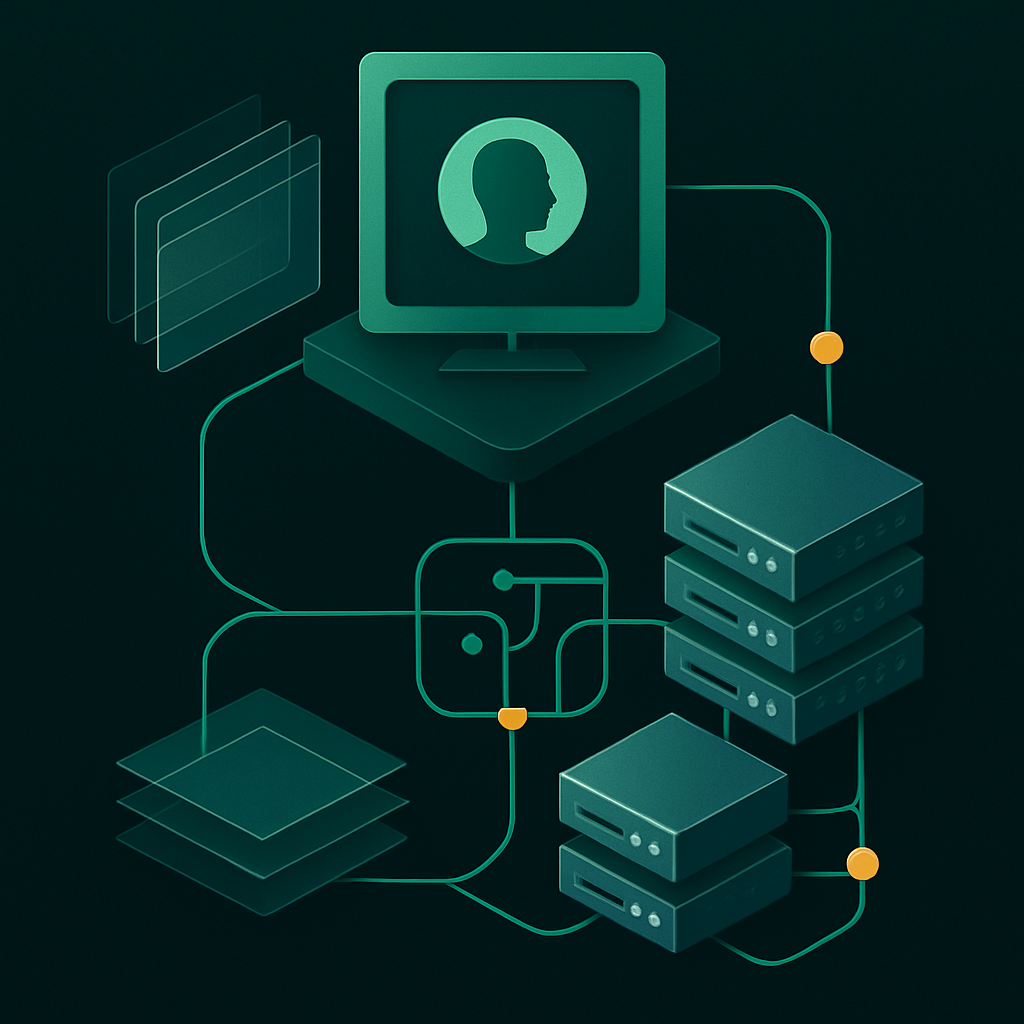
The CoE’s technical architecture sits at the intersection of data engineering, AI services, and security. Figure 1 visualizes the high‑level flow:
Figure 1: Governance flow from executive sponsorship to technical working groups, illustrated with emerald and amber strokes for clarity.
Key architectural layers include:
- Data Ingestion & CDC: Real‑time Change Data Capture (CDC) pipelines feed structured data into a contextual store, while traditional ETL jobs populate legacy reference datasets.
- Context Store: A purpose‑built vector database (e.g., Milvus or Pinecone) that holds embeddings alongside metadata tags defined by the MCP schema.
- Orchestration Layer: A gRPC‑based microservice that negotiates context bundles, enforces policy, and emits audit events to a centralized SBOM repository.
- Application Layer: Internal SaaS products, external APIs, and low‑code portals consume MCP payloads via REST or gRPC, abstracting model choice behind a unified SDK.
3. Funding Model & Economic Governance
Financial stewardship is as critical as technical stewardship. The CoE should adopt a hybrid funding approach:
- Core Budget (40%): Covers staff, governance tooling, and baseline infrastructure (VPC, IAM, KMS).
- Innovation Reserve (30%): Funds proof‑of‑concepts, pilot integrations, and emerging model licenses.
- Cost‑Recovery Pool (30%): Charged back to business units based on consumption metrics (CPU‑seconds, token usage, storage GB).
Transparent charge‑back dashboards linked to the enterprise financial system enable CFOs to track ROI in real time. Benchmarks from early adopters show a 3.5× payback period when MCP reduces duplicate model calls across five business units.
4. Success‑Metric Framework
Measuring impact requires a multi‑dimensional scorecard that balances technical health, compliance posture, and business outcomes. Table 1 outlines a recommended metric set.
| Dimension | Metric | Target | Frequency |
|---|---|---|---|
| Technical Performance | Average context retrieval latency | <200 ms | Weekly |
| Model Efficiency | Tokens per business‑critical response | Reduce 15% | Monthly |
| Compliance | Percentage of context bundles with GDPR audit tags | 100% | Quarterly |
| Financial | Cost‑per‑MCP‑call vs. legacy API | ‑25% cost | Quarterly |
| Adoption | Number of active business units using MCP SDK | ≥8 of 10 | Bi‑monthly |
Each metric should be visualized on a live dashboard powered by an analytics stack (e.g., OpenTelemetry + Prometheus + Grafana) and tied to executive KPIs.
Organizational Blueprint: Roles & Responsibilities
Executive Sponsorship
The C‑suite champion—typically the Chief Digital Officer or VP of AI—authorizes budget, removes inter‑departmental roadblocks, and publicly commits to MCP as a strategic asset.
Steering Committee
A cross‑functional body (Legal, Security, Data Science, Architecture, Finance) meets monthly to review policy updates, approve new model vendors, and assess risk exposure.
MCP Working Group
Day‑to‑day owners include:
- CoE Lead (Director‑level): Owns roadmap, staffing, and stakeholder communication.
- Architects: Design integration patterns, define SDK contracts, and ensure alignment with enterprise VPC and IAM strategies.
- Data Engineers: Build CDC pipelines, maintain the vector store, and enforce ELT/ETL best practices for context freshness.
- Security Engineers: Implement TLS/mTLS, manage KMS keys, and audit JWT signatures for every context exchange.
- Compliance Analysts: Map MCP metadata to GDPR, HIPAA, and SOC 2 controls, and generate SBOM evidence for audit trails.
Community of Practice
Beyond the core team, a community of practice (CoP) consisting of product managers, domain experts, and citizen developers fuels adoption. Regular brown‑bag sessions, internal hackathons, and an MCP knowledge base lower the learning curve.
Governance Framework in Detail
Policy Lifecycle
Policies progress through four states:
- Draft: Authored in a Git‑backed repository, reviewed by the security champion.
- Review: Circulated to the steering committee; feedback captured via pull‑request comments.
- Approved: Signed off by the executive sponsor; versioned and stored in an immutable SBOM.
- Enforced: Deployed to the orchestration engine through a CI/CD pipeline that validates schema compliance.
Automated linting ensures every MCP manifest includes required fields—context_id, source_system, data_classification, and retention_policy.
Audit & Traceability
Every context exchange generates a signed audit record (JWT) stored in an append‑only log. The log is ingested into a SIEM for real‑time alerts on anomalous token usage, satisfying both internal risk management and external regulator inquiries.
Funding & Cost‑Optimization Strategies
Baseline Infrastructure Costing
Assuming a mid‑size enterprise with 5 PB of vector data, a typical cloud‑native stack (managed VPC, auto‑scaling compute, encrypted storage) runs at roughly $0.12 / GB / month for storage plus $0.03 / CPU‑hour for inference. By consolidating model calls through MCP, organizations have reported a 20% reduction in compute spend.
Vendor Negotiation Playbook
When procuring commercial LLM licenses, embed the following clauses:
- Usage‑based pricing tied to token count, with a cap linked to MCP‑estimated volume.
- Right‑to‑audit language that permits inspection of model‑output logs for compliance.
- Exit‑on‑non‑performance guarantees tied to latency SLAs (e.g., 95th‑percentile < 200 ms).
Charge‑Back Mechanism
Implement a metered API gateway that tags each request with a cost code derived from the business unit’s budget line. The gateway reports usage to the finance ERP, enabling quarterly reconciliation.
Measuring Business Value
Revenue Impact
Case studies show that MCP‑enabled conversational assistants increase average order value (AOV) by 7% and reduce cart abandonment by 12%. When scaled across 10 product lines, the incremental revenue can exceed $15 M annually.
Operational Efficiency
By standardizing context retrieval, support ticket resolution time drops from 48 hours to 12 hours—a 75% improvement. This translates to roughly 3,200 fewer tickets per year for a 10,000‑agent contact center, saving $1.2 M in labor costs.
Risk Mitigation
Automated PII redaction in MCP payloads reduces GDPR‑related breach exposure by an estimated $3.5 M per incident, based on IBM’s 2023 data breach cost average.
Roadmap to CoE Maturity
Phase 0 – Foundations (0‑3 months)
- Secure executive sponsor and allocate core budget.
- Establish steering committee and draft initial governance charter.
- Deploy minimal MCP orchestration service in a sandbox VPC.
Phase 1 – Pilot Expansion (3‑9 months)
- Onboard two high‑visibility use cases (e.g., sales enablement chatbot, regulatory document search).
- Implement CDC pipelines for source systems and integrate with the vector store.
- Roll out compliance tagging and audit logging.
Phase 2 – Enterprise‑Wide Adoption (9‑18 months)
- Publish SDKs for internal developer portals and external partners.
- Scale to ten business units, enforce charge‑back, and publish quarterly ROI reports.
- Achieve SOC 2 Type II compliance for the MCP platform.
Phase 3 – Optimization & Innovation (18‑36 months)
- Introduce model‑selection engine that auto‑routes requests to the most cost‑effective LLM based on context complexity.
- Integrate with emerging Retrieval‑Augmented Generation (RAG) frameworks for multimodal data (e.g., video embeddings).
- Continuously refine success metrics, targeting a 40% reduction in total AI spend.
Conclusion
A purpose‑built MCP Center of Excellence transforms a scattered collection of pilot projects into a strategic, measurable, and compliant AI capability. By aligning governance, funding, and success metrics, senior leaders can ensure that the Model Context Protocol delivers tangible business value while safeguarding data privacy and regulatory adherence. The roadmap outlined here equips enterprises to move from experimental adoption to mature, enterprise‑wide AI orchestration—turning MCP from a technical curiosity into a core competitive advantage.