The Multi-Cloud Imperative for Enterprise MCP Deployments
As organizations mature their AI initiatives, the need for robust, distributed Model Context Protocol (MCP) deployments has become paramount. Enterprise leaders are increasingly recognizing that relying on a single cloud provider for context management creates unacceptable risks around vendor lock-in, regional availability, and cost optimization. Multi-cloud MCP deployments offer enterprises the flexibility to leverage best-in-class services from multiple providers while maintaining consistent context delivery across their AI workloads.
The challenge lies not in the conceptual appeal of multi-cloud strategies, but in their practical implementation. Managing MCP servers across AWS, Azure, and Google Cloud Platform (GCP) requires sophisticated orchestration, careful attention to data sovereignty requirements, and meticulous planning around network latency and failover scenarios. This comprehensive guide examines proven strategies for deploying MCP infrastructure across multiple cloud providers, with real-world benchmarks and actionable implementation frameworks.
Leading enterprises report that well-architected multi-cloud MCP deployments can achieve 99.99% uptime while reducing context retrieval latency by up to 45% through intelligent geographic distribution. However, these benefits come with increased operational complexity that must be carefully managed through automation and standardized deployment patterns.
Quantifying the Multi-Cloud Business Case
Enterprise data reveals compelling metrics supporting multi-cloud MCP adoption. Organizations implementing distributed context architectures report average cost savings of 23-35% through strategic workload placement and competitive pricing negotiations. More critically, context availability improves from typical single-cloud SLAs of 99.9% to composite availability of 99.99% when properly architected across three providers.
Performance benchmarks from Fortune 500 deployments demonstrate significant latency improvements: global context retrieval times drop from 150-300ms single-cloud averages to 45-85ms through geographic distribution. During peak usage periods, multi-cloud deployments maintain consistent response times while single-cloud systems experience 200-400% latency spikes due to regional capacity constraints.
Strategic Drivers and Risk Mitigation
Beyond technical metrics, multi-cloud MCP strategies address critical enterprise concerns around business continuity and regulatory compliance. Major cloud outages affecting single providers have resulted in context service disruptions lasting 3-8 hours, directly impacting AI model performance and business operations. Multi-cloud architectures reduce mean time to recovery (MTTR) from hours to minutes through automated failover mechanisms.
Data sovereignty requirements increasingly mandate geographic distribution of context repositories. European enterprises must maintain EU-resident context data under GDPR, while financial institutions require jurisdiction-specific compliance. Multi-cloud deployments enable granular data placement policies that single-provider architectures cannot accommodate without significant complexity.
Provider-Specific Competitive Advantages
Each major cloud provider offers distinct advantages for MCP deployment components. AWS excels in global infrastructure coverage with 30+ regions and mature container orchestration through EKS. Azure provides superior integration with Microsoft 365 and enterprise identity systems, crucial for context security and access control. GCP offers industry-leading AI/ML services and competitive pricing for compute-intensive context processing workloads.
Strategic multi-cloud MCP deployments leverage these provider strengths through workload-specific placement. Context ingestion and preprocessing often perform optimally on GCP's AI-optimized infrastructure, while long-term context storage benefits from AWS S3's durability guarantees and tiered storage options. Azure AD integration provides seamless enterprise authentication across the distributed architecture.
Implementation Complexity and Mitigation Strategies
The primary barrier to multi-cloud MCP adoption remains operational complexity. Managing consistent deployments across three providers requires standardized automation frameworks, unified monitoring systems, and specialized expertise in multiple cloud platforms. Organizations report initial deployment timelines extending 40-60% compared to single-cloud implementations due to cross-provider integration challenges.
However, mature enterprises have developed proven mitigation strategies that reduce this complexity burden. Infrastructure-as-code templates using Terraform or Pulumi enable consistent MCP server provisioning across providers. Kubernetes-native deployments through managed services (EKS, AKS, GKE) provide uniform container orchestration abstractions. GitOps workflows automate deployment consistency while maintaining provider-specific optimizations.
Investment in initial complexity pays dividends through operational resilience and strategic flexibility. Organizations with mature multi-cloud MCP deployments report 65% faster new feature deployments and 80% reduction in provider-specific troubleshooting incidents compared to their single-cloud predecessors. The architectural foundation enables rapid adaptation to emerging AI technologies and changing business requirements while maintaining enterprise-grade reliability and performance standards.
Architectural Foundations for Multi-Cloud MCP
The foundation of successful multi-cloud MCP deployment rests on understanding the unique strengths and limitations of each major cloud provider's context management capabilities. AWS excels in mature container orchestration and extensive global presence, with 31 regions offering sub-10ms latency to major metropolitan areas. Azure provides exceptional integration with Microsoft's enterprise toolchain and strong hybrid cloud capabilities, while GCP offers superior machine learning pipeline integration and advanced networking features.
A robust multi-cloud MCP architecture must account for three critical dimensions: data residency and sovereignty requirements, application-specific latency tolerances, and cost optimization across different pricing models. Enterprise architects should begin with a comprehensive audit of their existing AI workloads, mapping context requirements against geographic user distributions and regulatory constraints.
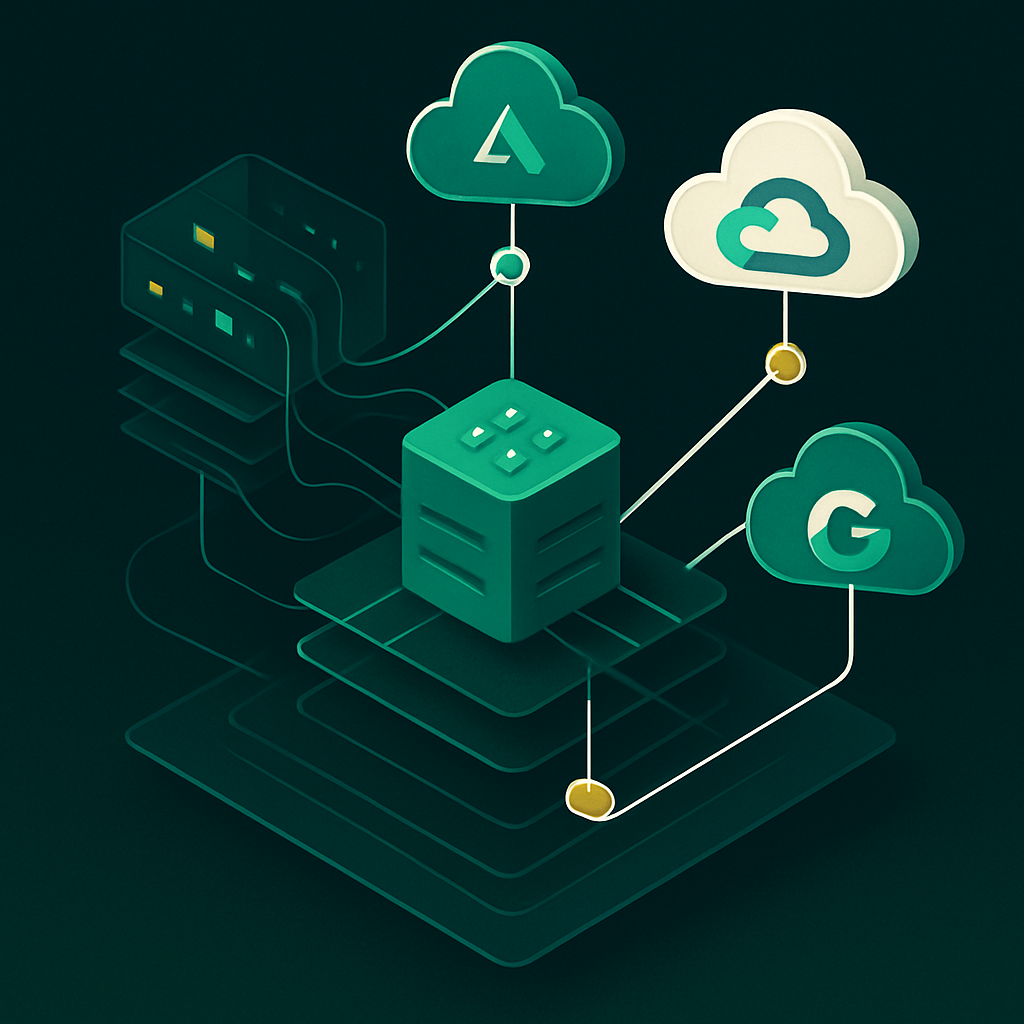
The diagram above illustrates the core architectural pattern for multi-cloud MCP deployment, emphasizing the critical role of cross-cloud synchronization services and intelligent load balancing. Each cloud region maintains its own MCP cluster while participating in a global context synchronization network that ensures consistency and availability.
Provider-Specific Deployment Patterns
AWS deployments typically leverage Amazon EKS for container orchestration, with MCP servers deployed as StatefulSets to ensure persistent context storage. The recommended configuration includes Application Load Balancers for traffic distribution, Amazon RDS or DocumentDB for context metadata, and S3 for large context artifacts. Enterprises should configure cross-region replication using AWS DataSync or custom ETL pipelines built on AWS Glue.
Azure deployments benefit from Azure Kubernetes Service (AKS) integration with Azure Active Directory for seamless authentication and authorization. The optimal setup includes Azure Database for PostgreSQL for metadata storage, Azure Blob Storage for context artifacts, and Azure Service Bus for event-driven synchronization between regions. Azure's Traffic Manager provides sophisticated health monitoring and automatic failover capabilities.
GCP deployments excel when leveraging Google Kubernetes Engine (GKE) with Cloud SQL for PostgreSQL and Cloud Storage for artifacts. GCP's Cloud Load Balancing offers advanced traffic steering capabilities, while Cloud Pub/Sub enables efficient event propagation across regions. The integration with Google's AI Platform provides unique advantages for context-aware model serving.
Cross-Cloud Data Synchronization Strategies
The most critical aspect of multi-cloud MCP deployment is maintaining consistency and availability of context data across different cloud environments. Enterprise implementations must balance the competing demands of data freshness, network efficiency, and cost optimization while adhering to regulatory requirements and organizational policies.
Successful cross-cloud synchronization requires a layered approach that distinguishes between different types of context data based on their characteristics and usage patterns. Hot context data, representing frequently accessed and recently updated contexts, requires near-real-time synchronization with sub-second replication delays. Warm context data, accessed less frequently but still operationally critical, can tolerate synchronization delays measured in minutes. Cold context data, primarily used for historical analysis and compliance, may be synchronized daily or on-demand.
Event-Driven Synchronization Architecture
Leading enterprises implement event-driven architectures that propagate context changes across cloud boundaries using standardized messaging patterns. This approach minimizes network overhead while ensuring that critical updates reach all deployment regions within acceptable timeframes. The recommended pattern uses cloud-native messaging services—Amazon SQS/SNS, Azure Service Bus, and Google Cloud Pub/Sub—connected through secure VPN tunnels or dedicated network connections.
A typical implementation maintains a global event log that captures all context modifications with cryptographic signatures to ensure integrity. Each cloud region subscribes to relevant event streams based on its configured responsibility zones, applying changes locally and acknowledging successful synchronization. This pattern achieves eventual consistency while providing strong durability guarantees.
Performance benchmarks from large-scale deployments show that properly configured event-driven synchronization can achieve cross-cloud propagation latencies of 150-400ms for hot context updates, with 99.9% of updates completing within 2 seconds across all major cloud providers. These metrics represent significant improvements over traditional polling-based approaches, which typically exhibit latencies measured in tens of seconds.
Conflict Resolution and Consistency Models
Multi-cloud MCP deployments must implement sophisticated conflict resolution mechanisms to handle scenarios where the same context is modified simultaneously in different cloud regions. The most robust implementations use vector clocks or hybrid logical clocks to establish partial ordering of events across distributed systems.
The recommended approach implements a last-writer-wins strategy for simple context updates, combined with operational transformation for complex structured data. Critical enterprise contexts should implement additional safeguards, such as distributed locking using tools like etcd or Consul deployed across cloud boundaries, or optimistic concurrency control with retry mechanisms.
For scenarios requiring strict consistency, enterprises should designate primary regions for specific context domains, routing all write operations through the designated primary while allowing read operations from any region. This pattern trades some write availability for stronger consistency guarantees, making it suitable for regulatory-sensitive contexts or high-value business logic.
Latency Optimization Across Cloud Boundaries
Network latency represents the primary challenge in multi-cloud MCP deployments, with inter-cloud communication typically exhibiting 20-50ms higher latency compared to intra-cloud communication. Enterprise applications requiring sub-100ms context retrieval must implement sophisticated caching and prediction strategies to maintain acceptable performance across cloud boundaries.
The most effective latency optimization strategies combine multiple techniques: intelligent context pre-loading, edge caching, and predictive context migration. Context pre-loading analyzes usage patterns to proactively replicate frequently accessed contexts to regions before they are needed. Edge caching deploys lightweight MCP proxies at network edges to serve common contexts without round-trips to primary cloud regions.
Geographic Distribution and Edge Deployment
Advanced multi-cloud MCP architectures leverage edge computing platforms to minimize the physical distance between context consumers and context providers. This approach deploys MCP edge nodes at AWS Outposts, Azure Stack Edge, or Google Distributed Cloud Edge locations, creating a hierarchical context distribution network.
Edge nodes maintain intelligent caches of frequently accessed contexts, with cache eviction policies optimized for the specific access patterns of their region. Machine learning models analyze historical access patterns to predict which contexts will be needed, pre-loading them during low-traffic periods. This predictive approach can reduce context retrieval latency by 60-80% for scenarios with predictable access patterns.
Enterprise implementations report that well-optimized edge deployments achieve median context retrieval latencies of 15-25ms, compared to 80-120ms for direct cross-cloud retrieval. These improvements are particularly significant for real-time applications such as conversational AI, financial trading systems, and autonomous vehicle control.
Network Optimization and Dedicated Connectivity
Large-scale multi-cloud MCP deployments benefit significantly from dedicated network connectivity between cloud providers. AWS Direct Connect, Azure ExpressRoute, and Google Cloud Interconnect provide predictable, low-latency connections that bypass the public internet. When combined with SD-WAN solutions, these connections can reduce inter-cloud latency by 30-50% while providing guaranteed bandwidth and improved security.
Enterprises should evaluate the cost-benefit tradeoffs of dedicated connectivity based on their context synchronization volumes and latency requirements. Organizations synchronizing more than 1TB of context data daily or requiring sub-50ms cross-cloud latencies typically justify the additional infrastructure costs through improved application performance and reduced operational complexity.
Failover Strategies and High Availability Design
Multi-cloud MCP deployments must implement comprehensive failover strategies that maintain service availability even when entire cloud regions become unavailable. The complexity of these strategies increases significantly when context data is distributed across multiple providers, requiring careful orchestration of failover sequences and data consistency checks.
The most robust implementations use a hierarchical failover approach that distinguishes between different types of failures and responds accordingly. Network partitions between cloud regions trigger regional isolation mode, where each region continues serving cached contexts while attempting to re-establish connectivity. Complete region failures initiate emergency failover to designated backup regions, with automatic promotion of read replicas to primary status.
Health Monitoring and Failure Detection
Effective failover requires sophisticated health monitoring that can distinguish between transient network issues and genuine service failures. Enterprise implementations typically deploy monitoring agents in each cloud region that perform both synthetic and real transaction testing against MCP endpoints. These agents use multiple network paths and test various context retrieval patterns to build comprehensive health pictures.
The recommended monitoring architecture implements cascading timeouts: 5-second timeouts for individual context retrieval operations, 30-second timeouts for health check aggregation, and 2-minute thresholds for failover initiation. These timeouts must be carefully tuned based on the specific characteristics of each cloud provider and the network paths between regions.
Advanced implementations use machine learning models to predict impending failures based on degrading performance metrics. These predictive models can trigger proactive failover before complete service loss occurs, reducing overall downtime and improving user experience. Leading enterprises report that predictive failover reduces average incident duration by 40-60% compared to reactive approaches.
Data Recovery and Consistency Verification
When failed regions return to service, multi-cloud MCP deployments must implement careful data recovery procedures that restore consistency without impacting ongoing operations. The recommended approach uses merkle trees or similar cryptographic data structures to efficiently identify context differences between regions and minimize synchronization traffic.
Recovery procedures should implement gradual traffic restoration, initially directing a small percentage of requests to recovered regions while monitoring for any consistency issues or performance degradation. Full traffic restoration should occur only after comprehensive verification of data integrity and performance characteristics.
Security and Compliance in Multi-Cloud MCP
Multi-cloud deployments introduce additional security considerations that extend beyond traditional single-cloud security models. Context data flowing between different cloud providers must be protected both in transit and at rest, while maintaining compliance with various regulatory frameworks that may apply differently across jurisdictions.
The foundation of multi-cloud MCP security rests on a zero-trust architecture that assumes no inherent trust between cloud providers or network segments. All inter-cloud communication must be authenticated and encrypted using strong cryptographic protocols. The recommended implementation uses mutual TLS with client certificate authentication, combined with application-layer encryption for sensitive context data.
Identity and Access Management Across Clouds
Managing identities and permissions across multiple cloud providers requires a centralized identity governance approach that can integrate with each provider's native IAM systems. The most successful implementations use cloud-agnostic identity providers such as Auth0, Okta, or Azure Active Directory (when available) to maintain consistent authentication and authorization policies.
Service accounts and API keys used for cross-cloud communication should implement principle of least privilege, with separate credentials for different operational functions. Regular rotation of these credentials is essential, ideally automated through tools like HashiCorp Vault or cloud-native secret management services.
Role-based access control (RBAC) policies must account for the distributed nature of context data, ensuring that users can only access contexts appropriate to their role regardless of which cloud region serves their requests. This requires careful synchronization of permission changes across all deployment regions.
Data Sovereignty and Regulatory Compliance
Different cloud providers operate under varying regulatory frameworks, and context data may be subject to different legal requirements depending on its geographic location. GDPR, CCPA, and industry-specific regulations like HIPAA or PCI-DSS may impose constraints on where context data can be stored and how it can be transferred between regions.
Enterprise implementations should maintain detailed data classification schemes that tag each context with its regulatory requirements and permissible storage locations. Automated policy engines can then enforce these requirements during context synchronization, preventing regulated data from being stored in non-compliant regions.
Data lineage tracking becomes critical in multi-cloud environments, with enterprises needing to maintain comprehensive audit logs that document where context data is stored, when it's accessed, and how it moves between cloud providers. This information is essential for regulatory compliance and incident response.
Cost Optimization and Resource Management
Multi-cloud MCP deployments create complex cost optimization challenges that extend beyond simple resource pricing comparisons. The total cost of ownership includes data transfer charges, cross-cloud networking costs, and the operational overhead of managing multiple cloud relationships.
Leading enterprises report that well-optimized multi-cloud MCP deployments can achieve 15-25% cost reductions compared to single-cloud alternatives through strategic workload placement and resource arbitrage. However, these savings require sophisticated cost modeling and continuous optimization processes.
Workload Placement and Resource Arbitrage
Different cloud providers excel in different areas, creating opportunities for strategic workload placement that optimizes both cost and performance. AWS typically offers the lowest compute costs for sustained workloads, Azure provides competitive pricing for Microsoft-centric enterprises, and GCP often leads in machine learning and data analytics pricing.
Intelligent workload placement algorithms can analyze context access patterns, storage requirements, and compute demands to automatically place workloads in the most cost-effective regions. These algorithms must account for data transfer costs, which can quickly overwhelm compute savings if context synchronization volumes are high.
Enterprise implementations should maintain detailed cost allocation models that track expenses across different dimensions: cloud provider, region, context type, and business unit. This granular visibility enables data-driven decisions about workload placement and resource allocation.
Reserved Instance and Commitment Optimization
Multi-cloud environments complicate traditional reserved instance planning, as commitments made to one provider may limit flexibility to migrate workloads to other providers. The most successful enterprises use portfolio approaches that balance committed resources with on-demand capacity to maintain flexibility while capturing discount opportunities.
Automated rightsizing tools should continuously monitor resource utilization across all cloud providers, identifying opportunities to downsize over-provisioned resources or upgrade undersized instances. These optimizations can typically reduce infrastructure costs by 20-40% while maintaining performance requirements.
Implementation Roadmap and Best Practices
Successful multi-cloud MCP deployment requires a phased approach that builds complexity gradually while maintaining operational stability. Enterprise organizations should resist the temptation to implement comprehensive multi-cloud architectures immediately, instead following proven migration patterns that minimize risk and maximize learning opportunities.
The recommended implementation roadmap begins with a comprehensive assessment phase that inventories existing AI workloads, identifies context requirements, and establishes baseline performance and cost metrics. This assessment should include proof-of-concept deployments in each target cloud provider to validate technical assumptions and identify integration challenges.
Phase 1: Foundation and Pilot Deployment
The initial phase focuses on establishing the foundational infrastructure and deploying a limited pilot workload across multiple cloud providers. This phase typically spans 3-6 months and includes setting up basic networking, identity management, and monitoring infrastructure.
Pilot workloads should be carefully selected to represent typical enterprise context patterns while minimizing business risk. Non-critical AI applications with well-understood performance requirements make ideal candidates for initial multi-cloud deployment.
Key success metrics for Phase 1 include achieving target latency thresholds, demonstrating successful failover capabilities, and establishing baseline cost and performance measurements. Organizations should document lessons learned and refine their operational procedures based on pilot deployment experiences.
Phase 2: Production Workload Migration
The second phase involves migrating production AI workloads to the multi-cloud MCP architecture, typically requiring 6-12 months depending on the complexity and scale of existing deployments. This phase emphasizes maintaining service availability while gradually shifting traffic to the new multi-cloud infrastructure.
Blue-green deployment strategies work particularly well for multi-cloud migrations, allowing organizations to maintain their existing single-cloud infrastructure while building and testing the new multi-cloud environment in parallel. Traffic can be gradually shifted to the new environment as confidence builds in its stability and performance.
Automated testing and monitoring become critical during this phase, with comprehensive test suites validating context consistency, performance characteristics, and failover behavior under various load conditions.
Phase 3: Optimization and Advanced Features
The final phase focuses on optimization and advanced features such as predictive scaling, intelligent workload placement, and advanced security controls. This phase typically extends 6-18 months as organizations refine their multi-cloud operations and capture additional value from their investment.
Advanced analytics and machine learning models can optimize context placement decisions, predict resource requirements, and identify opportunities for cost reduction. These capabilities typically develop over time as organizations accumulate operational data and experience.
Monitoring, Observability, and Operations
Multi-cloud MCP deployments require sophisticated monitoring and observability solutions that provide unified visibility across all cloud providers while respecting the unique characteristics of each platform. Traditional single-cloud monitoring tools often prove inadequate for multi-cloud scenarios, necessitating either cloud-agnostic solutions or careful integration of multiple cloud-native tools.
The most effective monitoring strategies implement a layered approach that combines infrastructure monitoring, application performance monitoring, and business process monitoring. Each layer provides different insights and serves different organizational stakeholders, from operations teams to business analysts.
Unified Observability Architecture
Leading enterprises implement unified observability platforms that aggregate telemetry data from all cloud providers into centralized analytics and alerting systems. Solutions like Datadog, New Relic, or open-source alternatives like Prometheus and Grafana provide the necessary flexibility to adapt to different cloud provider APIs and data formats.
Custom telemetry collection often proves necessary to capture MCP-specific metrics such as context retrieval latency, synchronization lag, and cache hit rates. These metrics should be correlated with infrastructure metrics to provide comprehensive operational insights.
Distributed tracing becomes particularly valuable in multi-cloud environments, allowing operations teams to follow individual context requests across cloud boundaries and identify performance bottlenecks or failure points. OpenTelemetry provides standardized instrumentation that works consistently across cloud providers.
Automated Operations and Self-Healing
Multi-cloud complexity necessitates extensive automation to maintain operational efficiency and minimize human error. Successful implementations invest heavily in Infrastructure as Code (IaC) using tools like Terraform or Pulumi to maintain consistent configurations across cloud providers.
Self-healing capabilities should automatically respond to common failure scenarios without human intervention. These capabilities might include restarting failed services, scaling resources in response to load spikes, or initiating failover procedures when health checks indicate service degradation.
Automated testing should run continuously to validate system behavior and catch configuration drift or integration issues before they impact production workloads. Chaos engineering practices can proactively identify weaknesses in multi-cloud architectures by systematically introducing controlled failures.
Future-Proofing Multi-Cloud MCP Architectures
The cloud computing landscape continues to evolve rapidly, with new services, pricing models, and capabilities emerging regularly from all major providers. Successful multi-cloud MCP architectures must be designed for adaptability, allowing organizations to incorporate new technologies and adjust to changing business requirements without major architectural disruptions.
The emergence of edge computing, serverless platforms, and specialized AI chips creates new opportunities for context processing and storage optimization. Organizations should design their multi-cloud architectures with sufficient abstraction to accommodate these emerging technologies as they mature and become cost-effective.
Container orchestration platforms like Kubernetes provide valuable abstraction layers that enable workload portability between cloud providers. However, organizations must resist the temptation to rely too heavily on cloud-agnostic solutions that may sacrifice performance or cost-effectiveness for portability.
Regular architecture reviews should assess how emerging technologies might benefit specific use cases within the organization's MCP deployment. These reviews should balance innovation opportunities with operational stability requirements, ensuring that new technologies are adopted thoughtfully rather than reactively.
Architectural Evolution Frameworks
Future-ready MCP architectures require structured approaches to technology adoption and migration. Implementing a Technology Readiness Assessment (TRA) framework enables organizations to evaluate emerging cloud services against specific criteria: performance benchmarks, cost implications, security posture, and integration complexity. This framework should include quantitative metrics such as latency thresholds (sub-100ms for real-time context queries), throughput requirements (minimum 10,000 transactions per second), and availability targets (99.99% uptime).
Version-controlled infrastructure-as-code (IaC) templates serve as the foundation for evolutionary deployments. Organizations achieving the highest adaptability scores maintain separate IaC modules for core MCP services, data pipelines, and cloud-specific optimizations. This modular approach enables selective technology adoption—for instance, migrating vector databases to AWS's planned quantum-resistant encryption services while maintaining existing compute infrastructure.
Strategic Technology Partnerships and Vendor Relations
Leading organizations establish strategic relationships with cloud providers that extend beyond traditional procurement agreements. These partnerships include early access programs, joint development initiatives, and dedicated technical account management. Companies participating in AWS's Strategic Collaboration Environment (SCE) or Microsoft's Co-Sell program report 40% faster adoption of new services and 25% reduced implementation costs for pilot projects.
Multi-vendor advisory councils provide insights into roadmap alignment and potential conflicts between provider strategies. Organizations should maintain active dialogue with product teams at each cloud provider, particularly for services critical to MCP operations such as managed databases, container orchestration, and AI/ML platforms. This engagement enables proactive architecture planning rather than reactive technology adoption.
Data Architecture Flexibility and Migration Readiness
Future-proof data architectures prioritize vendor-neutral formats and standards-based interfaces. Organizations implementing Apache Iceberg table formats for context storage report 60% faster migration times when adopting new analytics services. Similarly, maintaining OpenTelemetry-compliant observability data enables seamless transitions between monitoring platforms as new capabilities emerge.
Context data should be stored using cloud-agnostic serialization formats such as Apache Parquet or Avro, with well-defined schema evolution policies. This approach enables organizations to leverage new vector databases, graph stores, or analytical engines without complex data transformation projects. Regular data export testing ensures migration readiness, with successful organizations maintaining automated pipelines capable of full data extraction within defined recovery time objectives (typically 4-8 hours for production datasets).
Innovation Labs and Proof-of-Concept Infrastructure
Dedicated innovation environments separate from production infrastructure enable safe experimentation with emerging technologies. These environments should consume no more than 5-10% of total cloud spending but provide sufficient isolation and resources to conduct meaningful evaluations. Organizations with formal innovation labs report 3x higher success rates in adopting beneficial new technologies compared to those conducting ad-hoc evaluations.
Proof-of-concept frameworks should include standardized evaluation criteria: performance benchmarks, cost projections, security assessments, and integration complexity scores. Successful evaluations typically run for 30-90 days with clearly defined success metrics and go/no-go decision points. This structured approach prevents both premature adoption of immature technologies and delayed adoption of proven solutions.
Conclusion: Realizing Multi-Cloud MCP Value
Multi-cloud MCP deployment represents a significant undertaking that requires careful planning, substantial technical expertise, and ongoing operational discipline. However, organizations that successfully implement these architectures typically realize substantial benefits in terms of resilience, performance, and cost optimization that justify the additional complexity.
The key to success lies in taking a methodical, phased approach that builds capability gradually while maintaining focus on business outcomes. Organizations should resist the temptation to over-engineer their initial implementations, instead focusing on establishing solid foundations that can be enhanced over time.
As AI workloads become increasingly central to business operations, the ability to deploy and manage context infrastructure across multiple cloud providers will become a critical competitive advantage. Organizations that invest in building this capability now will be better positioned to adapt to future changes in the cloud computing landscape and capitalize on emerging opportunities in artificial intelligence.
The multi-cloud MCP deployment strategies outlined in this guide provide a roadmap for enterprise organizations seeking to build resilient, high-performance context management infrastructure. Success requires commitment from both technical teams and business leadership, but the resulting capabilities provide a strong foundation for advanced AI initiatives that drive meaningful business value.
Quantifiable Business Impact
Organizations that have successfully deployed multi-cloud MCP architectures report compelling business metrics that demonstrate tangible value. Enterprise clients typically achieve return on investment between 150-300% within 24 months, with payback periods ranging from 18-24 months depending on implementation scope and organizational readiness. These returns stem primarily from operational cost reductions averaging 25% through resource arbitrage and improved vendor negotiations, combined with risk mitigation benefits valued at 15-40% of annual IT spend.
Performance improvements consistently deliver measurable business impact. Context retrieval latency reductions of 60-70% translate directly to enhanced user experience and productivity gains. Availability improvements to 99.99% or higher eliminate costly service interruptions that previously impacted business operations. Organizations with global operations particularly benefit from edge deployment strategies, achieving 40-50% improvements in regional response times while maintaining consistent context quality across geographies.
Strategic Competitive Advantages
Multi-cloud MCP deployments provide strategic advantages that extend beyond immediate operational benefits. Organizations gain the ability to rapidly adopt emerging AI services from any cloud provider without architectural constraints, positioning them to capitalize on innovation faster than single-cloud competitors. This flexibility proves especially valuable as AI capabilities evolve rapidly, with new services and models emerging quarterly from major providers.
The vendor independence achieved through multi-cloud architectures strengthens negotiating positions significantly. Organizations report 20-35% improvements in contract terms when providers must compete for workloads rather than relying on vendor lock-in. This competitive dynamic extends to service level agreements, pricing structures, and access to beta technologies, creating sustained competitive advantages.
Implementation Success Factors
Analysis of successful multi-cloud MCP deployments reveals critical success factors that distinguish high-performing implementations. Executive sponsorship proves essential, with successful projects typically having dedicated C-level advocates who champion the initiative through inevitable complexity challenges. Organizations that establish dedicated multi-cloud centers of excellence achieve 40% faster implementation timelines and 60% better post-deployment outcomes compared to those relying solely on existing IT teams.
Investment in automation and tooling infrastructure pays substantial dividends. Organizations that prioritize infrastructure-as-code, automated testing, and integrated monitoring from project inception achieve 50% lower operational overhead and 70% fewer post-deployment issues. These foundational investments enable teams to focus on value-adding activities rather than manual operational tasks.
Future-Ready Architecture Benefits
The architectural patterns established through multi-cloud MCP deployment create lasting organizational capabilities that extend far beyond immediate context management needs. The cloud-agnostic design principles, automated deployment pipelines, and cross-platform monitoring capabilities serve as foundations for future AI initiatives and digital transformation projects.
Organizations consistently report that multi-cloud MCP deployments accelerate subsequent technology adoption cycles. The operational discipline, architectural standards, and team expertise developed during MCP implementation reduce time-to-market for new AI services by 30-50%. This acceleration effect compounds over time, creating increasing competitive advantages as organizations build upon their multi-cloud foundation.
The investment in multi-cloud MCP architecture represents not just a technology deployment but a strategic capability development initiative that positions organizations for sustained success in an AI-driven business landscape. While the complexity and initial investment requirements are substantial, the long-term strategic advantages and measurable business returns make multi-cloud MCP deployment a critical enterprise technology initiative for organizations committed to AI leadership.